

A stuffy, heavy face can make it hard to focus on anything else. A sinus massage is one of the simplest things to try at home. It needs no equipment, costs nothing and takes about two minutes.
This guide walks you through a gentle routine for each sinus area, explains honestly what massage can and can’t do for congestion, and shows which home measures to pair it with. You’ll also find the signs that mean it’s time to call a doctor.
Quick Answer: How to Do a Sinus Massage
Warm your face with a warm compress, then use light fingertip pressure: small circles above the inner eyebrows, gentle presses beside the bridge of your nose, outward strokes under your cheekbones and slow strokes down the sides of your neck. Spend 15 to 30 seconds on each area. Sinus massage can ease pressure and feel soothing, but it is a comfort measure, not a cure for an infection.
Table of Contents
Does Sinus Massage Work?
Sinus massage can make a congested face feel better, but it’s best thought of as a comfort measure. Your sinuses are air-filled spaces inside the bones of your face, so pressing on the skin can’t squeeze mucus straight out of them. Ear, nose and throat (ENT) specialists interviewed by TODAY doubted that massage drains the sinuses, while agreeing it may ease how sore and tight the face feels.
The research is thin. Cleveland Clinic notes that no research studies back sinus massage as a treatment. One small study of 35 women with sinus headaches found average pain scores fell from about 6 to about 3 out of 10 after a 15-minute face and head massage. It had no comparison group, so the result is encouraging rather than proof.
In practice, that means using it for comfort and relaxation, and pairing it with the measures that have stronger support, which are covered below.
Where Are Your Sinuses?
You have four pairs of sinuses. Knowing roughly where they sit helps you aim your fingertips:
- Frontal sinuses: in your forehead, just above the inner ends of your eyebrows.
- Ethmoid sinuses: between your eyes, behind the bridge of your nose.
- Maxillary sinuses: the largest pair, behind your cheekbones on either side of your nose.
- Sphenoid sinuses: deep behind the nose. Massage can’t reach them, but the temple and neck strokes in the routine may still help you relax.
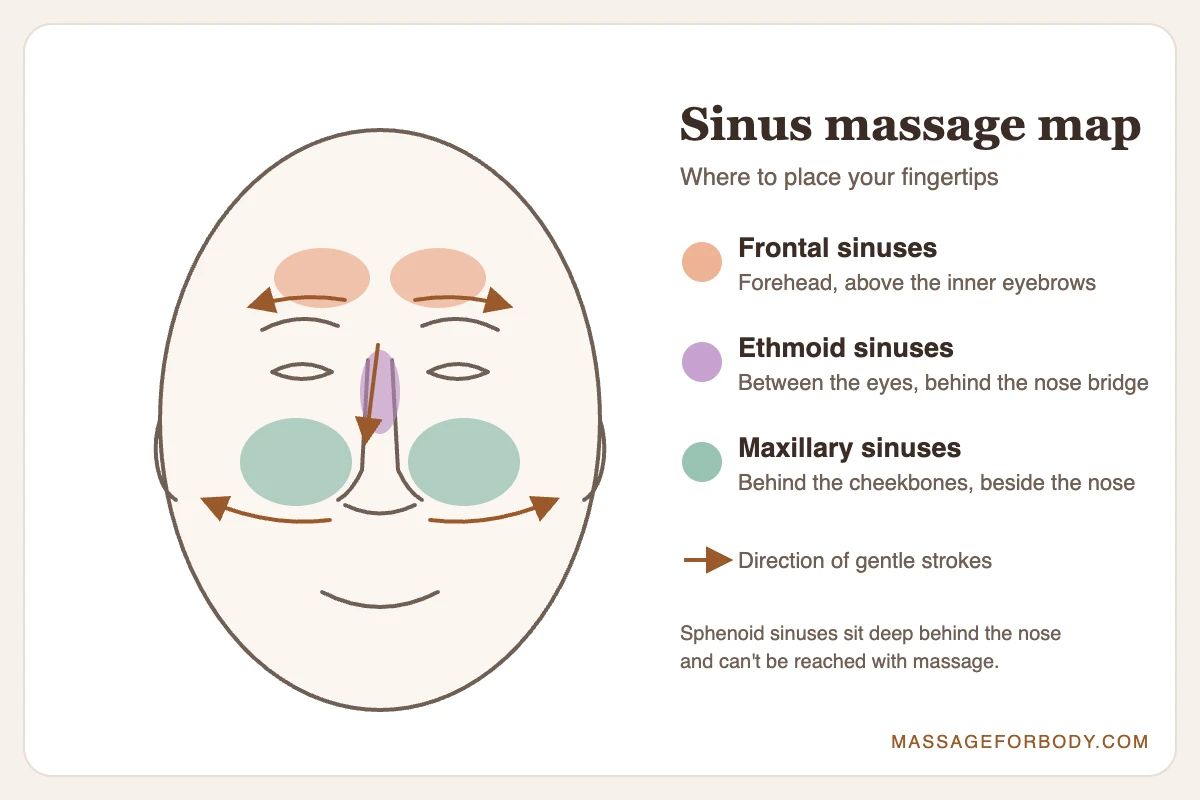
Pressure, fullness or tenderness over these areas is common with congestion, whether it comes from a cold, allergies or a sinus infection.
How to Do a Sinus Massage: A 2-Minute Routine
Sit or lie down somewhere comfortable, wash your hands and use the pads of your fingers. Pressure should be light to moderate: firm enough to feel, never painful. Around the eyes, keep it very gentle. If you like, add a drop of facial oil or moisturizer so your fingers glide.
Step 1: Warm Up (30 Seconds)
Hold a warm, damp washcloth over your nose and forehead. The CDC lists a warm compress as a way to ease sinus pressure, and the warmth makes the massage more comfortable. Test the temperature on the inside of your wrist first.
Step 2: Forehead and Frontal Sinuses (20 Seconds)
Place your index and middle fingers just above the inner ends of your eyebrows. Make small, slow circles for about 10 seconds, then sweep outward along the brow line toward your temples. Repeat three times.
Step 3: Between the Eyes and Ethmoid Sinuses (20 Seconds)
Find the spot where the bridge of your nose meets the inner corners of your eye sockets. Press gently with one fingertip on each side for 5 seconds, release, and repeat three times. Keep your fingers on the bone and off the eyes themselves.

Step 4: Cheeks and Maxillary Sinuses (30 Seconds)
Place your fingertips beside your nostrils at the base of your cheekbones. Make a few small circles, then stroke outward under the cheekbones toward your ears. Repeat five times. Many people find this the most relieving step.
Step 5: Sides of the Nose (10 Seconds)
With light pressure, stroke downward along both sides of your nose, from the bridge to the nostrils, five times.
Step 6: Temples, Jaw and Neck (20 Seconds)
Finish with slow circles on your temples, then glide your fingertips down the sides of your neck, from behind your jaw toward your collarbones. Keep this stroke light and stay on the sides of the neck rather than the front of your throat. Our self neck massage guide has more ideas if your neck and shoulders feel tight too.

You can repeat the routine two or three times a day while you’re stuffed up. Stop if any step causes sharp pain, dizziness or a headache that gets worse.
Sinus Pressure Points to Try
Some people like to add acupressure points from traditional Chinese medicine. Evidence that they relieve sinus symptoms is limited, so treat them as optional extras. Press each one with steady, gentle pressure for 30 seconds to a minute:
- LI20 (Yingxiang): in the small groove beside each nostril, where the nose meets the cheek.
- BL2 (Zanzhu): at the inner end of each eyebrow, in the slight dip on the brow bone.
- Yintang: midway between the eyebrows.
- GB20 (Fengchi): at the back of your head, in the hollows under the base of the skull on either side of the neck muscles.
Our guide to headache pressure points covers more spots, including which ones to avoid during pregnancy.
How to Get More Relief From a Sinus Massage
Massage works best as one part of a simple routine. The CDC and Mayo Clinic suggest these measures for sinus and nasal congestion:
- A warm compress over your nose and forehead before or after massage.
- Steam from a hot shower or a bowl of hot (not boiling) water.
- Saline nasal spray or rinse to keep the nasal passages moist. If you use a neti pot or rinse bottle, the FDA says to use distilled or sterile water, or tap water boiled for 3 to 5 minutes and cooled to lukewarm. Never use water straight from the tap.
- Plenty of fluids, such as water or broth.
- Over-the-counter decongestant or allergy medicine, used exactly as the label says. Ask a pharmacist first if you have high blood pressure, are pregnant or take other medicines.
- Avoiding triggers such as cigarette smoke and known allergens.
If your eyes look puffy too, see our tips on massaging under-eye bags. A lymphatic face massage uses similarly light strokes, and our face massage techniques hub has more routines to try.

Who Should Skip Sinus Massage?
Gentle facial massage is low-risk for most adults, but check with a doctor first, or skip it, if you:
- have had facial, nasal, sinus or eye surgery recently, or a facial injury
- had fillers, Botox or another cosmetic injection in the area recently (ask your provider when massage is safe)
- have a skin infection, rash, cold sore or broken skin on your face
- have severe facial pain or swelling, or a fever
- feel dizzy or light-headed when you press on your face
Cleveland Clinic warns that too much pressure on inflamed sinuses can make you feel light-headed or dizzy, which is one more reason to keep your touch light. For children, use only very gentle strokes and check with your pediatrician if symptoms linger.
When Should You See a Doctor About Sinus Pressure?
Most congestion from a cold improves on its own. The CDC and Mayo Clinic advise seeing a healthcare provider if you have:
- symptoms lasting more than 10 days without getting better
- a fever lasting longer than 3 to 4 days, or a high fever
- symptoms that get worse after they started to improve
- a severe headache or severe facial pain
- yellow or green nasal discharge together with sinus pain or fever
- bloody discharge, or a runny nose after a head injury
- several sinus infections in the past year
Get medical care right away for pain, swelling or redness around the eyes, double vision or other vision changes, confusion or a stiff neck. These can be signs of a more serious infection, according to Mayo Clinic. Call 911 if symptoms are severe or come on suddenly.

Frequently Asked Questions
How often can I do a sinus massage?
You can do a gentle sinus massage two or three times a day while you’re congested, or whenever your face feels tight and pressured. Each round only takes a couple of minutes. There’s no benefit to pressing harder or longer, and too much pressure can leave you sore or light-headed. If you still need it every day after 10 days, check in with a doctor.
Can sinus massage drain mucus from your sinuses?
Probably not directly. Your sinuses sit behind bone, so pressing on the skin can’t squeeze mucus out of them, and ENT specialists are skeptical of drainage claims. Massage may still help you feel less congested by relaxing tight facial muscles and easing tenderness. For thinning and rinsing mucus, saline sprays, rinses and steam have better support.
Is sinus massage safe for children?
Very light facial strokes are generally fine for older children who enjoy them. Keep the pressure feather-light and stop if your child pulls away or says it hurts. For babies, Mayo Clinic suggests saline drops and gentle suction with a bulb syringe for a stuffy nose. Call your pediatrician if symptoms don’t improve, get worse, or interfere with feeding or breathing.
Is carotid sinus massage the same as sinus massage?
No. Carotid sinus massage has nothing to do with your nasal sinuses. It’s a medical procedure in which a doctor presses on the carotid artery in the neck while monitoring the heart, because it can slow the heart rate and lower blood pressure. Never try it at home, and avoid firm pressure on the front of your throat during any neck massage.
Does sinus massage help a sinus headache?
It may help. In one small study, women with sinus headaches reported their pain dropping from about 6 to about 3 out of 10 after a 15-minute face and head massage, although the study had no comparison group. Massage is a reasonable comfort measure alongside other care. A severe headache, high fever or stiff neck needs a doctor rather than massage.
The Bottom Line
Sinus massage is a free, gentle way to ease the heavy, pressured feeling that comes with congestion. Keep your touch light, spend a few seconds on each sinus area, and pair the routine with warmth, steam and saline for the best chance of relief.
Think of it as comfort care rather than a cure. If your symptoms last more than 10 days, keep coming back, or come with a high fever or swelling around the eyes, let a doctor take a look.
References
- Cleveland Clinic. Sinus Massage: How To Do It and Why It Helps.
- Centers for Disease Control and Prevention. Sinus Infection Basics.
- Mayo Clinic. Nasal congestion: When to see a doctor.
- Mayo Clinic. Acute sinusitis: Symptoms and causes.
- U.S. Food and Drug Administration. Is Rinsing Your Sinuses With Neti Pots Safe?
- TODAY. Do sinus massages work to relieve pain and nasal congestion?
- Bahraini S. The effect of facial and head massage on the pain severity of sinus headache. Journal of Paramedical Sciences & Rehabilitation. 2014;3(1):68–73.
Disclaimer:
This article is for general information only and is not a substitute for professional medical advice, diagnosis or treatment. Talk to your doctor or another qualified healthcare provider about sinus symptoms that are severe, lasting or worrying, and call 911 or seek emergency care for urgent symptoms.








Love this blog! The content is always so relevant and insightful, keep up the great work!