
Watery eyes, a permanent damp patch on one cheek, crusty lashes every morning. A blocked tear duct is one of the most common things to worry a new parent, and one of the least dangerous. More than 5% of babies are born with one, usually because a thin membrane at the bottom of the tear duct has not finished opening.
The frustrating part is the advice. Search for it and you will find circular rubbing, outward strokes, warm compresses and cotton buds, most of it describing a technique that is not the one paediatric eye services actually teach. There is a specific method, it has a name, and the direction you move your finger is the entire point of it.
👶 Quick Answer: Blocked Tear Duct Massage
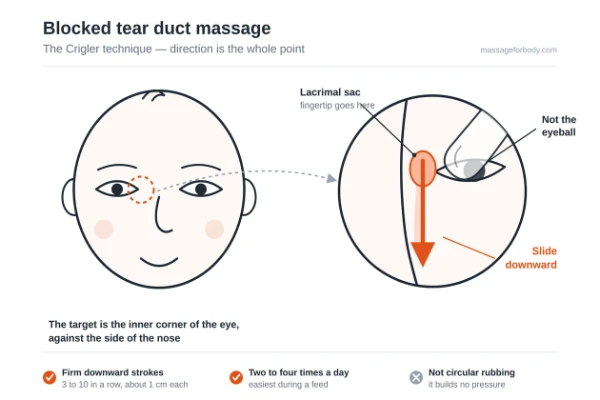
Blocked tear duct massage, known clinically as the Crigler technique, means pressing your fingertip into the inner corner of your baby’s eye, against the side of the nose, and sliding firmly downward. Do 3 to 10 short strokes, two to four times a day. The downward direction is what builds the pressure that opens the duct. Circular rubbing does not.
Table of Contents
What Is a Blocked Tear Duct in a Baby?
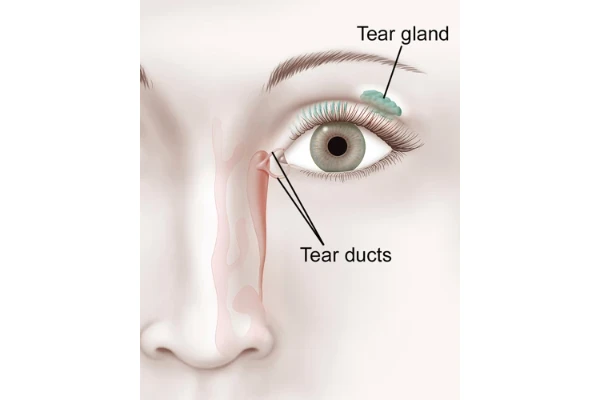
Tears drain out of the eye through two tiny openings in the inner corners of the eyelids, into a small reservoir beside the nose called the lacrimal sac, then down the nasolacrimal duct into the back of the nose. That is why crying makes your nose run.
In babies, the bottom end of that duct is often still covered by a membrane that should have opened before birth. Tears have nowhere to go, so they spill over the lid instead. The medical name is congenital nasolacrimal duct obstruction, and it affects more than 5% of newborns.
It looks worse than it is. A blocked duct does not hurt, does not affect vision and does not damage the eye. What you will see is constant watering on one or both sides, and often yellowish crusting on the lashes, especially after a nap. That crusting is pooled tears and mucus rather than an eye infection, though the two are easy to confuse.
Where Exactly Do You Press?
This is where most people go wrong, so it is worth finding the spot before you touch your baby at all.
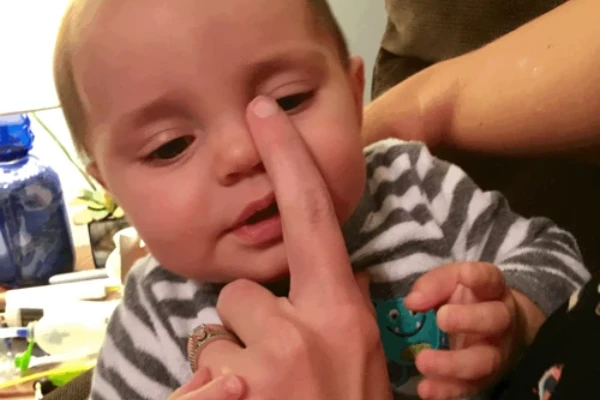
Put a fingertip on the inner corner of your own eye, right where the upper and lower lids meet next to the bridge of your nose. Slide it a few millimetres towards your nose and press gently. You should feel a soft area just below the bony ridge. That is over the lacrimal sac, and that is the target.
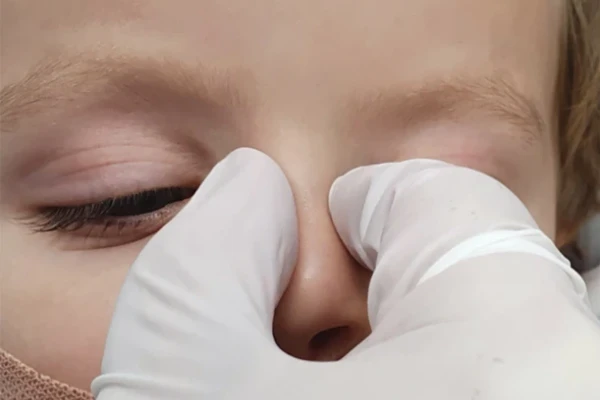
You are not touching the eyeball, and you are not on the eyelid itself. You are on the side of the nose, in the corner. On a newborn the whole area is smaller than a fingernail, so use the very tip of your little finger or index finger, whichever gives you more control. If you are new to handling your baby this closely, our guide to gentle baby massage techniques covers positioning and pressure.
How Do You Do the Crigler Massage, Step by Step?
The technique is named after the ophthalmologist who described it, and it works on a simple principle: seal the top of the drainage system, then push down. That builds pressure inside the sac, and the pressure is what opens the membrane at the bottom.
- Wash your hands with soap and warm water, and trim or file the nail on the finger you will use.
- Lay your baby down on a changing mat or across your lap, head supported and steady. Steady matters more than still.
- Place your fingertip in the inner corner of the affected eye, against the side of the nose, over the lacrimal sac.
- Press firmly enough to feel the tissue give, then slide downward along the side of the nose in one short, smooth stroke of about a centimetre. That downward slide is the technique. Everything else is setup.
- Lift, reposition and repeat. Three to ten strokes in a row, depending on how patient your baby is being.
- Wipe away any discharge with a clean damp cloth, working from the inner corner outward, using a fresh part of the cloth for each wipe.
On pressure. Firm is the word every paediatric source uses, and it throws parents. It means enough pressure to feel the tissue move under your finger, roughly what you would use to press a sticker onto a page, not enough to leave a mark. If your baby’s skin blanches white, ease off.
If your baby will not cooperate, which is most babies, do it during a feed. They are still, they are distracted, and you already have a free hand. Failing that, try mid nappy change when they are used to being handled. A stroke or two done properly beats ten done while they thrash. It is also worth knowing when it is safe to start massaging your newborn more generally.
How Often Should You Massage a Blocked Tear Duct?
Sources vary slightly, which is worth being upfront about rather than inventing false precision.
- Nationwide Children’s Hospital: 3 to 5 downward strokes, three times a day, morning, midday and night.
- StatPearls, the clinical reference text: 5 to 10 strokes, four times a day.
Anywhere in that range is reasonable. The consistent part is that it is a short, frequent action of a few seconds several times daily, not a five minute session. Tie it to feeds or nappy changes and it looks after itself, which is the same principle behind how often to massage your baby in general.
Keep going until the watering stops, or until your doctor tells you otherwise. Most cases take months rather than days.
Does Tear Duct Massage Actually Work?
Mostly the duct opens on its own. Up to 90% of blocked tear ducts clear without any treatment during the first year of life.
The strongest evidence on massage itself is a 2024 multicentre randomised controlled trial published in the British Journal of Ophthalmology by Asano and colleagues. Across 102 infants aged 3 to 11 months with a blockage on one side, one month of lacrimal sac massage made no significant difference to how many resolved compared with no massage at all.
The interesting part is the subgroup. Among the youngest infants, aged 3 to 5 months, whose parents actually followed the protocol properly, 68.8% resolved compared with 28.6% of controls. An earlier and much smaller study by Karti and colleagues, covering 36 eyes, found 96.2% resolution with massage against 77.7% without, and faster, at an average of 6.8 months versus 10.3.
Put together, the honest reading is that massage is most likely to help early, and only when it is actually done properly and consistently. Started late or done occasionally, the evidence suggests it probably will not change the outcome. That is a good argument for building it into feeds from the start. It is not a reason to worry if you have been doing it for weeks without much change.
When Should You Stop and See a Doctor?
Massage is for a plain blocked duct. If the lacrimal sac becomes infected, a condition called acute dacryocystitis, massage is the wrong thing to do, because pressure can push infection further into the tissues around the eye.
Stop and get same day medical advice if you see:
- a red, swollen, tender lump at the inner corner of the eye, beside the nose
- yellow-green pus, as opposed to the usual clear or pale crusting
- fever, or a baby who is unusually sleepy, floppy or off their feeds
- redness spreading onto the eyelid or cheek
- the white of the eye turning red
AAPOS describes infection of the tear sac as a medical emergency that needs antibiotics and sometimes hospital treatment. Do not wait it out.
Separately, stop massaging and check in with your GP if your baby cries every time you do it, or if the skin becomes red and irritated. That usually means too much pressure, or a nail catching.

What If It Has Not Cleared by 12 Months?
Twelve months is the standard decision point. If the duct is still blocked, the usual next step is probing, where an ophthalmologist passes a fine instrument through the duct to open the membrane. In babies it is sometimes done in the office with numbing drops. In older children it is normally done under general anaesthetic.
It is a short procedure with a high success rate, and it is a normal outcome rather than a sign that anything went wrong. If your baby is approaching a year with symptoms that have not budged, ask for a referral rather than continuing to massage indefinitely.
Does Blocked Tear Duct Massage Work for Adults?
Realistically, no, and this is where most articles on this topic do their readers a disservice.
Infant blockages are a membrane that has not opened yet, which is exactly the kind of thing pressure can shift. Adult blockages are different: narrowing that comes with age, scarring, chronic inflammation, nasal or sinus disease, previous injury, or occasionally a growth. None of those respond to pressing on the outside of your nose.
Gentle massage over the tear sac may help clear pooled discharge and ease a feeling of fullness, and a warm compress can make a watery eye more comfortable. Neither reopens the duct.
If your eye has been watering persistently, see an optometrist or ophthalmologist rather than massaging it for weeks. Persistent watering in an adult is a symptom worth having looked at, and the treatments that work all start with someone examining the duct.
Frequently Asked Questions
The Bottom Line
Blocked tear duct massage works when you get one thing right: press over the lacrimal sac in the inner corner of the eye and slide downward, firmly, a few strokes at a time, several times a day. Circular rubbing, outward strokes and massaging around the eye are all common advice, and none of them create the pressure that opens the duct.
Most blockages clear on their own within a year, and doing the massage properly and early appears to speed that up. What matters more than technique is knowing the line: a watery, crusty eye is a nuisance you can manage at home, while a red swollen lump beside the nose, pus or a fever is an infection that needs a doctor the same day.
If you are building a wider routine, our guides to relieving trapped wind with tummy massage, massage for a baby with a cough and settling a toddler to sleep with massage cover the rest of the early months.
📚 References
- Nasolacrimal Duct Obstruction – American Association for Pediatric Ophthalmology and Strabismus (AAPOS)
- Asano M, et al. Lacrimal sac massage for congenital nasolacrimal duct obstruction: a multicentre randomised controlled trial. British Journal of Ophthalmology, 2024;108(9):1281-1285.
- Crigler Technique for Congenital Nasolacrimal Duct Obstruction – StatPearls, NCBI Bookshelf
- Eye: Tear Duct Massage – Nationwide Children’s Hospital
- Karti O, Karahan E, Acan D, Kusbeci T. The natural process of congenital nasolacrimal duct obstruction and effect of lacrimal sac massage. International Ophthalmology, 2016.
- Blocked tear ducts – Children’s Health Queensland
⚠️ Disclaimer:
This article is for general informational purposes only and is not a substitute for professional medical advice, diagnosis or treatment. The technique described here is commonly taught by paediatric eye services, but your baby should be assessed by a GP, child and family health nurse or ophthalmologist before you begin. Seek urgent medical care if the inner corner of the eye becomes red, swollen and tender, if there is pus, or if your baby develops a fever.
About The Author