
When your baby has a cough, it is natural to want to do something that helps them feel calmer and more comfortable. Gentle massage can provide soothing touch, ease general restlessness and create a reassuring moment of closeness while your baby recovers.
Massage cannot cure a cough, treat an infection or clear mucus from your baby’s lungs. It should only be used as a comfort measure when your baby is alert, breathing normally and happy to be touched.
👶 At a glance: How to Massage a Baby With a Cough
To massage a baby with a mild cough, begin with calming contact before using gentle outward strokes across the upper chest. Massage the shoulders and arms, then use slow, flat-handed strokes over the upper back. Use very light pressure and stop if your baby becomes distressed or their breathing changes.
This guide explains how to massage a baby with a cough safely, including where to place your hands, how much pressure to use and when your baby needs medical care instead.
Table of Contents
Can Massage Help a Baby With a Cough?
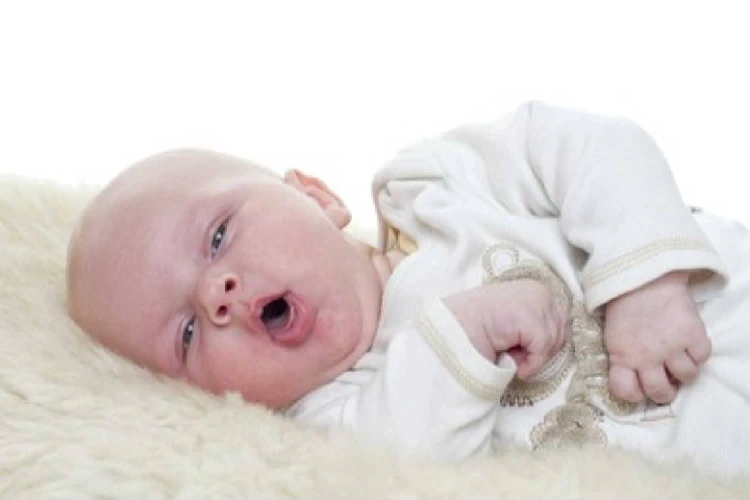
Gentle massage may help a coughing or mildly congested baby feel calmer, but it is important to have realistic expectations.
Coughing is a protective reflex that helps the body clear mucus and irritants from the lungs and airways. In babies and children, coughs are commonly caused by colds and other viral respiratory infections.[1]
A short massage may provide:
- comforting physical contact
- relaxation when your baby is restless
- a calming addition to their usual routine
- an opportunity for parent-and-baby bonding
- a chance to closely observe your baby’s breathing and behaviour
There is not strong evidence that ordinary baby massage can open the airways, improve oxygen levels, remove mucus from the lungs or shorten an illness.
Baby massage should also not be confused with chest physiotherapy. Percussion, vibration and postural drainage are clinical techniques used in particular medical circumstances. They should only be performed when a qualified healthcare professional has specifically recommended and demonstrated them for your baby.
Before You Massage Your Baby
Gentle massage may be appropriate when your baby has mild cough or cold symptoms but is otherwise breathing and behaving normally.
When Gentle Massage May Be Appropriate
You can consider a short massage when your baby:
- is awake and responsive
- is breathing comfortably
- has their normal skin and lip colour
- appears calm and receptive to touch
- is feeding reasonably well
- has a mild cough without signs of breathing difficulty
Wait until a coughing episode has passed before beginning. Trying to massage your baby during a coughing fit may make them more unsettled.
It is also best to wait at least 30 minutes after a feed. Lying down and being handled immediately after feeding could make your baby uncomfortable or cause them to bring up milk.
Speak with your baby’s doctor before attempting massage if your baby is very young, has an existing medical condition or has been diagnosed with bronchiolitis, RSV, croup, pneumonia or whooping cough.
Bronchiolitis affects the small airways of babies and may cause difficulty breathing and feeding. Younger babies and those with underlying heart or lung conditions have a greater chance of needing hospital care.[2]
When You Should Not Massage Your Baby
Do not begin or continue a massage when your baby:
- is struggling to breathe
- is breathing noticeably faster than usual
- has skin pulling in around or beneath the ribs
- is wheezing, grunting or making a harsh breathing sound
- has pale, grey or blue lips or skin
- is unusually sleepy, floppy or difficult to wake
- cannot feed comfortably because of their breathing
- is crying inconsolably
- is in the middle of a coughing fit
- has just finished feeding
- appears to be getting worse
Turning away, stiffening, crying, arching the back or repeatedly avoiding eye contact can also indicate that your baby has had enough. Treat these behaviours as a cue to pause or stop.
If anything about your baby’s breathing worries you, seek medical advice rather than continuing the massage.
What You Need
You do not need any specialist equipment. Prepare:
- a warm, quiet room
- a firm and safe surface at floor level
- clean, warm hands
- a towel in case your baby spits up
- comfortable clothing that allows access to the massage area
Remove rings, bracelets and watches that could scratch your baby. Check that your fingernails are smooth.
Your baby does not need to be completely undressed. Leaving their nappy and some clothing on can help them remain warm and comfortable.
Parents who are new to infant massage may also find our guide to when and how to begin baby massage helpful before trying this routine.
Do You Need Baby Massage Oil?
Massage oil is optional. You can perform the routine over a light layer of clothing or use gentle strokes directly on the skin.
When using a product, choose a small amount of plain, fragrance-free oil or lotion designed for babies. Use something your baby has tolerated before, or patch-test a new product on a small area of skin.
Avoid using:
- essential oils
- eucalyptus oil
- peppermint oil
- menthol or camphor rubs
- adult vapour rubs
- strongly fragranced lotions
- warming balms
Strong fragrances and concentrated oils can irritate sensitive skin and may be uncomfortable around a baby’s nose and airways.
How to Massage a Baby With a Cough
Begin with still contact, then use light outward strokes across your baby’s upper chest. Massage the shoulders and arms before using slow, flat-handed back strokes. Finish with the hands, legs or feet.
This routine is intended to provide comfort when your baby has a mild cough or congestion. Use feather-light pressure and follow your baby’s cues throughout.
The entire massage can take approximately five to ten minutes. A shorter session is perfectly fine, particularly when your baby is tired or unwell.
1. Begin With Calming Contact
Lay your baby on their back on a safe, firm surface.
Place one warm hand gently over the upper chest and the other over the abdomen or legs. Do not press down. Simply allow your hands to remain still for several breaths.
Speak softly, make eye contact or hum a familiar song. This gives your baby time to recognise your touch before you begin moving your hands.
Watch your baby’s face and breathing. Continue only when they appear relaxed and comfortable.
2. Use Gentle Outward Chest Strokes
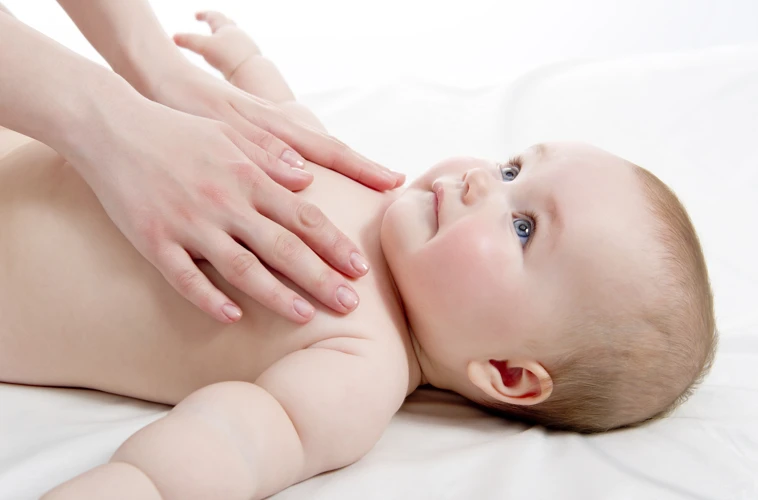
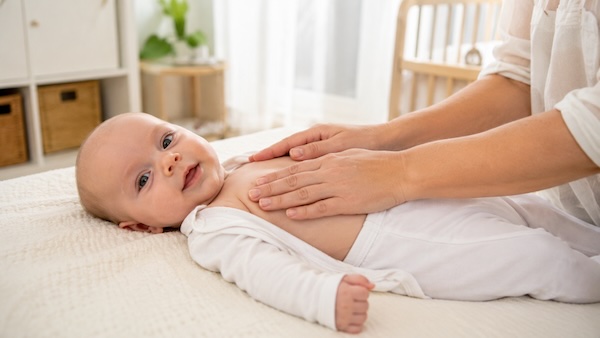
Place both hands flat near the centre of your baby’s upper chest.
Slowly glide your hands outward toward the shoulders, as though you are gently smoothing the pages of an open book. Lift your hands, return them to the centre and repeat.
Complete three to five slow strokes.
A baby chest massage should always use very light pressure. Avoid pushing down on the ribs or breastbone, and never massage the front or sides of the throat.
These strokes are intended to feel relaxing. They do not physically open the airways or remove mucus from the lungs.
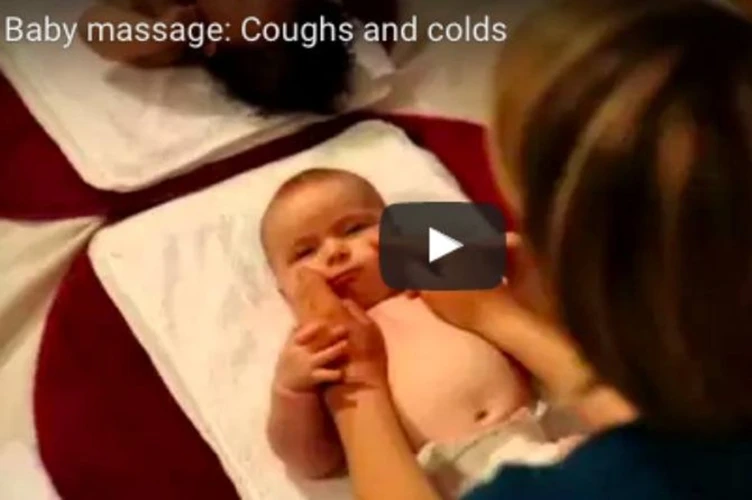
3. Massage the Shoulders and Upper Arms
Place your fingertips gently over one shoulder and make small, slow circles.
Glide your hand from the shoulder toward the upper arm. Repeat on the other side.
You can then hold your baby’s arm softly between your hands and glide toward the wrist. Avoid squeezing, pulling or twisting.
Coughing, disrupted sleep and general discomfort may leave babies restless. Including the shoulders and arms helps the session feel like a calming whole-body massage rather than a treatment focused only on the chest.
For more general techniques, see our complete guide to pediatric massage for parents.
4. Massage the Hands
Gently open your baby’s palm and use your thumb to make small circles across it.
Lightly roll each finger between your fingertips before moving to the other hand.
Hand massage can be a useful alternative when your baby does not enjoy lying on their tummy for a back massage.
5. Use Slow Upper-Back Strokes
Only include tummy-down massage when your baby is awake, supervised and comfortable in that position.
Place your baby across your lap or on a safe, firm surface. Turn their head comfortably to one side and make sure their nose and mouth remain completely unobstructed.
Rest one hand gently on their upper back. With your other hand, glide slowly from the shoulders toward the lower back.
Repeat the movement several times using a flat hand and very light pressure.
You can also make small circles on either side of the spine. Do not press directly over the spine, ribs or neck.
Gentle back massage may feel soothing when coughing has left your baby restless, but it should not be used in an attempt to force mucus from the lungs.
If tummy time appears uncomfortable while your baby is congested, hold them upright against your chest instead and use slow downward strokes over their back.
6. Finish With the Legs and Feet
Gently glide your hands from one thigh toward the ankle. Repeat on the other leg.
Use your thumb to make small circles over the sole of each foot. Finish by resting your hands over your baby’s feet or legs for a few moments.
Ending with an area away from the chest can help the massage finish calmly.

When digestive discomfort is also making your baby unsettled, our guide explains how to help a baby poop with massage using gentle tummy techniques.
Should You Tap a Baby’s Back to Loosen Mucus?
A gentle pat while holding and comforting your baby is different from chest percussion.
Do not use forceful, repetitive or cupped-hand tapping in an attempt to loosen mucus unless a healthcare professional has specifically shown you how and advised you to do it for your baby.
Clinical chest physiotherapy is used in particular medical circumstances and is not a general home remedy for an ordinary cough.
For a baby with a mild cough, slow back strokes or gentle reassuring pats are more appropriate than percussion.
Other Ways to Comfort a Coughing or Congested Baby
Massage can be used alongside suitable home-care measures when your baby is breathing comfortably and does not require medical treatment.
Offer Regular Feeds
Continue offering breastmilk or formula. A congested baby may find feeding tiring, so smaller and more frequent feeds may be easier.
Watch for signs of dehydration, such as fewer wet nappies, a dry mouth or unusual sleepiness.
Try Saline Nasal Drops
Baby-safe saline drops may help soften mucus in a blocked nose. They can be particularly useful before a feed when congestion is making it harder for your baby to suck and breathe comfortably.
Follow the product instructions and ask a pharmacist or health professional when you are unsure which product is appropriate.
Use Gentle Nasal Suction
A baby nasal aspirator may help remove softened mucus near the front of the nose.
Use suction gently and only when needed. Frequent or forceful suction can irritate the delicate lining inside your baby’s nose.
Keep the Air Free From Irritants
Keep your baby away from:
- cigarette smoke
- vaping residue
- incense
- aerosol sprays
- strong perfumes
- diffused essential oils
Smoke and vaping exposure can make respiratory symptoms worse.[2]
Consider a Cool-Mist Humidifier
A clean cool-mist humidifier may make a dry room feel more comfortable. However, evidence that humidifiers improve coughs is limited.[3]
Keep the humidifier well away from your baby and clean it according to the manufacturer’s instructions. Poorly maintained humidifiers can allow mould or bacteria to grow.
Cough Remedies to Avoid for Babies
Do not give your baby a remedy simply because it is described as natural.
Avoid giving babies:
- over-the-counter cough and cold medicines
- decongestants unless medically prescribed
- herbal cough syrups without professional advice
- honey before 12 months of age
- essential oils by mouth or on the skin
- adult chest rubs or vapour products
Over-the-counter cough and cold medicines can harm babies. Honey should not be given to babies younger than 12 months because of the risk of infant botulism.[4]
You should also never prop up a cot mattress or add pillows, wedges, rolled towels or sleep positioners to help with congestion.
Place your baby on their back to sleep on a firm, flat surface. Keep pillows, soft bedding and other loose items out of the cot or bassinet.[5]
When to Seek Medical Help for a Baby’s Cough
A cough can sometimes indicate that your baby needs prompt medical assessment.
Call emergency services immediately if your baby:
- is struggling to breathe
- turns blue, grey or very pale
- is choking
- has pauses in their breathing
- is floppy, extremely drowsy or unresponsive
- cannot feed because of breathing difficulty
Seek prompt medical advice if:
- your baby is breathing faster or harder than usual
- the skin is pulling in around the ribs or neck
- they are wheezing, grunting or making a harsh sound while breathing
- they are drinking substantially less than usual
- they have fewer wet nappies
- repeated coughing causes vomiting
- the cough began after a possible choking episode
- they appear unusually tired or irritable
- their symptoms are getting worse rather than improving
- you are worried for any reason
A baby younger than three months with a temperature of 38°C or higher should be assessed promptly by a healthcare professional. Babies younger than one month with a fever above 38°C should be taken to hospital.[6]
Trust your instincts. You know your baby best, and you do not need to wait until symptoms become severe before seeking medical help.
Frequently Asked Questions
Can Massage Loosen Mucus in a Baby’s Chest?
There is not good evidence that ordinary baby massage can loosen mucus deep inside the lungs. Gentle chest and back strokes may comfort your baby, but they should not be presented as a way to clear the airways.
Where Should I Massage a Baby With a Cough?
Use gentle strokes over the upper chest, shoulders, upper arms, back, hands, legs and feet. Avoid placing pressure over the throat, breastbone, ribs or spine.
How Do You Massage a Congested Baby?
When your baby is mildly congested but breathing normally, use very light outward strokes over the upper chest and slow, flat-handed strokes over the back.
Keep their face and airways unobstructed, avoid the throat and ribs, and stop if they become distressed. Massage may provide comfort, but it does not treat an infection or remove mucus from the lungs.
Can I Massage My Baby During a Coughing Fit?
Wait until the coughing episode has passed and your baby is breathing comfortably.
Hold them upright and offer calm reassurance while they are coughing. Do not attempt chest or back massage in the middle of a coughing fit.
Is Chest Tapping Safe for Babies?
Gentle comforting pats may be appropriate, but forceful or repetitive chest percussion should not be attempted unless a qualified healthcare professional has taught you the technique for your baby’s specific condition.
What Oil Can I Use for Baby Chest Massage?
Oil is not required. When using one, choose a plain, fragrance-free baby massage product your baby has previously tolerated.
Avoid essential oils, menthol, camphor and adult vapour rubs.
Can I Massage a Newborn With a Cough?
Newborns can become unwell quickly. Speak with a doctor or child health nurse when a newborn develops a cough.
Seek medical advice promptly if their feeding, breathing, alertness or temperature changes.
How Long Should the Massage Last?
Begin with approximately five minutes. Continue for up to ten minutes only when your baby remains relaxed and appears to enjoy the massage.
Stop immediately if they become unsettled.
How Often Can I Massage a Baby With a Cough?
A short massage once or twice a day may be enough when your baby enjoys it and remains comfortable.
Do not continue simply to follow a schedule. Stop whenever your baby shows signs of tiredness, discomfort or distress.
Can Massage Help a Congested Baby Sleep?
A calming massage may help your baby relax before sleep, but it will not necessarily clear their congestion.
Stop if lying down appears to worsen your baby’s coughing or discomfort. After the massage, follow recognised safe-sleep guidance and place your baby on their back on a firm, flat surface.

When digestive discomfort is also making your baby unsettled, our guide to baby massage for gas explains gentle tummy techniques and important safety precautions.
Final Thoughts
Learning how to massage a baby with a cough is less about treating the cough and more about providing calm, reassuring touch.
Gentle outward chest strokes, slow back massage and soothing hand or foot movements may help your baby relax when they have a mild cough and are otherwise breathing comfortably.
Keep the massage brief, use very light pressure and follow your baby’s signals.
Most importantly, seek professional help whenever your baby has difficulty breathing, feeds poorly, becomes unusually sleepy or simply does not seem like themselves.
📚 References
- How to Comfort a Coughing Baby – BabyCentre UK
- Cough in Infants and Children – Johns Hopkins Medicine
- American Academy of Pediatrics. “Coughs and Colds: Medicines or Home Remedies?” HealthyChildren.org
- National Institute of Child Health and Human Development. “Safe Sleep Environment for Baby.” Safe to Sleep®.
⚠️ Medical disclaimer:
This article provides general information only and is not a substitute for advice from a doctor or other qualified health professional. Babies can become unwell quickly. Seek medical advice if you are concerned about your baby’s breathing, feeding, temperature or general condition.
About The Author