

Tennis elbow can make the simplest things hurt: shaking hands, lifting a coffee mug, turning a doorknob. It’s natural to rub the sore spot on the outside of your elbow, but that bony bump is where the irritated tendon attaches, and pressing hard there often makes it angrier.
This guide shows you where a tennis elbow massage actually helps, a 5-minute routine you can do at your desk, and why gentle strengthening exercises do most of the long-term work. It also covers what the research really says and the signs that mean it’s time to see a doctor.
Quick Answer: How to Massage Tennis Elbow
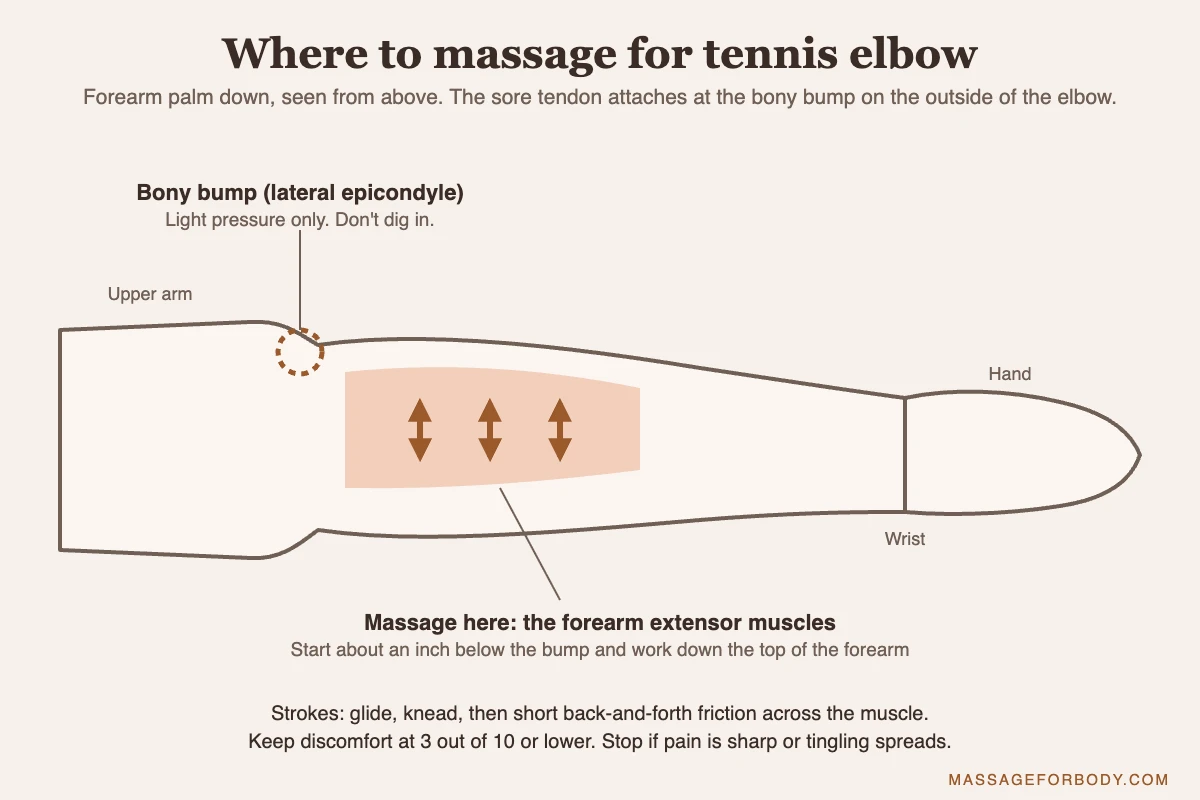
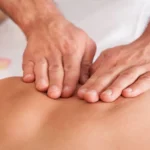
Massage the forearm muscles, not the bony bump. Starting about an inch below the outside of your elbow, glide, knead and then rub back and forth across the top of your forearm for about five minutes, keeping discomfort at 3 out of 10 or lower. Massage can ease pain for a while, but strengthening exercises are what help the tendon recover, so pair the two.
Table of Contents
Does Massage Help Tennis Elbow?
It can help you feel better in the short term, but it’s unlikely to fix tennis elbow on its own.
Tennis elbow (lateral epicondylitis) is an overuse injury of the tendon that attaches your forearm muscles to the outside of your elbow. According to the American Academy of Orthopaedic Surgeons (AAOS), the tendon most often involved belongs to a muscle called the extensor carpi radialis brevis, and most cases occur between the ages of 30 and 50. Painters, plumbers, carpenters, cooks and racquet sport players are at higher risk, but plenty of people develop it with no obvious cause.
Research on massage for tennis elbow is thin. A 2014 Cochrane review looked for trials of deep transverse friction massage, the classic therapist technique for this injury. It found only two small elbow studies of 20 people each, and neither showed a clear benefit for pain, grip strength or function when friction massage was added to other treatment. The reviewers rated the evidence as very low quality.
Physical therapy guidance takes a similar line. The University of British Columbia’s Lateral Elbow Tendinopathy Toolkit says clinicians may consider massage for short-term pain relief or as part of a wider program, but it strongly recommends exercise that gradually loads the forearm muscles.
The good news is that tennis elbow usually gets better. AAOS says 80% to 95% of people recover without surgery, which is generally considered only after 6 to 12 months of non-surgical treatment.

Is It Tennis Elbow or Golfer’s Elbow?
Both are overuse injuries of the forearm tendons, but they hurt in different places. Tennis elbow hurts on the outside of the elbow (the thumb side when your palm faces forward) and is usually worse when you grip, lift with your palm facing down or bend your wrist back. Golfer’s elbow hurts on the inside of the elbow and involves the muscles that bend your wrist and fingers.
Mayo Clinic notes that tennis elbow pain can spread into the forearm and wrist and make it hard to shake hands, turn a doorknob or hold a cup. If your pain is on the inner side instead, our guide to massage for golfer’s elbow covers the muscles to work.
Where to Massage for Tennis Elbow
Think “muscle, not bone.” The muscles involved run along the top of your forearm, from the outside of your elbow toward the back of your wrist. You can feel them tighten if you rest your forearm on a table, palm down, and lift the back of your hand toward the ceiling.
- Main target: the meaty part of the forearm, starting about an inch below the bony bump and running a few inches toward the wrist.
- Go gently near: the bony bump itself (the lateral epicondyle). Light strokes are fine; digging in with a thumb, knuckle or elbow is not.
- Worth a few strokes: the back of the wrist and the web between your thumb and index finger, which often tighten from gripping. If your wrist is the main problem, see our guide to massage for wrist tendonitis.
5-Minute Tennis Elbow Massage Routine
Sit at a table and rest your sore forearm on it, palm down, with a folded towel under your wrist. Use a little lotion or oil if your skin drags, and do the massage with your other hand.
- Warm up with gliding strokes (1 minute). With a flat palm, stroke from your wrist up toward your elbow using light to medium pressure. Glide back down lightly and repeat.
- Knead the muscle (1 minute). Gently squeeze and lift the top of your forearm between your thumb and fingers, working from just below the elbow toward the wrist.
- Find the tight spots (1 minute). Press slowly along the muscle with your thumb. When you find a tender spot, hold steady pressure for 20 to 30 seconds while you breathe out, then move on.
- Rub across the muscle (1 to 2 minutes). Place two fingers on the muscle about an inch below the bump and rub back and forth across it, not along it, in short strokes. Keep the pressure moderate and move to a new spot every 20 to 30 seconds.
- Finish with gliding strokes (30 seconds). Repeat the first step to settle the area.
Keep any discomfort at 3 out of 10 or lower. A good tennis elbow massage should feel like a “good hurt” that eases as you go, not a sharp or burning pain. Stop if the pain turns sharp, if tingling or numbness spreads into your hand, or if your elbow feels worse the next morning.
Once or twice a day is plenty. For a longer routine that includes the upper arm and shoulder, see our guide on how to massage an arm.

Using a Massage Ball or Massage Gun on Tennis Elbow
Tools can save your hand from tiring out, but the same rule applies: stay on the muscle.
- Massage ball: Place a tennis ball or massage ball on a table, rest your forearm on it palm down, and slowly roll from just below the elbow toward the wrist for 1 to 2 minutes. Lean in only as much as feels comfortable. Our guide on how to use a massage ball has more ideas.
- Massage gun: Use the softest attachment on the lowest setting and float it along the forearm muscle for 30 to 60 seconds. Don’t use it on the bony bump, on the inside of the elbow or over a swollen area.
- Ice massage: AAOS lists ice massage among the techniques physical therapists may use. Rubbing a paper cup of frozen water over the sore area for 5 to 10 minutes, keeping it moving, can calm things down after activity. Learn how in our guide to ice massage.

Pair Massage With These Two Exercises
Tendons recover by being loaded gradually, which is why exercise does the heavy lifting in tennis elbow recovery. The UBC toolkit found that no single type of exercise is clearly best; what matters most is choosing one you can do without making your pain worse. These two are common starting points, but a physical therapist can tailor a program to you.
1. Isometric wrist hold
Rest your forearm on a table, palm down, with your hand over the edge. Place your other hand on the back of your sore hand and push up into it so your wrist muscles tighten without moving. Hold for 30 to 45 seconds at a moderate effort, rest, and repeat 4 or 5 times. This is often the most comfortable place to start when your elbow is irritable.
2. Slow-lowering wrist extension
Hold a light weight, such as a can of soup or a water bottle, with your palm down and your forearm supported. Use your other hand to help lift the weight, then lower it slowly on your own over 3 to 4 seconds. Start with 1 set of 10 to 15 once a day and build up to 3 sets as it gets easier.
Mild discomfort during these exercises is common, but it should settle by the next day. If your elbow is worse the following morning, use a lighter weight or fewer repetitions. AAOS publishes a printable exercise program for epicondylitis you can review with your doctor or physical therapist.
Other Things That Help Tennis Elbow
- Ease off the aggravating grip. Rest from the activities that trigger your pain, and lift with your palm facing up when you can.
- Try a counterforce brace. A strap worn just below the elbow can take some strain off the tendon, especially early on.
- Use ice after activity. For elbow pain, Mayo Clinic suggests an ice pack for 15 to 20 minutes, up to three times a day.
- Check your technique and tools. AAOS recommends having racquet sport equipment and stroke technique checked. The same idea applies to tools, a computer mouse or knives at work.
- Ask about pain relief. Over-the-counter pain relievers or topical gels may help. Check with a pharmacist or doctor first, especially if you take other medicines.
If home care isn’t enough, a doctor may discuss other options, such as a steroid injection, platelet-rich plasma or shock wave therapy.

When to See a Doctor About Elbow Pain
Most tennis elbow can be managed at home, but get checked if things aren’t improving. Mayo Clinic advises:
- Go to the emergency room if your elbow looks deformed or out of place, or bone is visible.
- Get prompt medical care after a sudden injury, especially with a snap or crack, or if you have severe pain, swelling or bruising, or trouble moving your elbow or turning your palm up and down.
- Book an appointment if your pain continues despite home care, hurts even at rest, or comes with increasing redness or swelling.
It’s also worth seeing a doctor or physical therapist if you have numbness or tingling in your fingers, so they can rule out a nerve problem such as carpal tunnel syndrome.
Frequently Asked Questions
Should I massage tennis elbow where it hurts?
Not with heavy pressure. The sorest point is usually the bony bump on the outside of the elbow, where the irritated tendon attaches, and digging into it can aggravate the tendon. Light strokes over the bump are fine, but focus most of your massage on the forearm muscles, starting about an inch below it. Keep discomfort at 3 out of 10 or lower, and stop if the pain becomes sharp.
Is deep tissue massage good for tennis elbow?
Firm pressure on the forearm muscle is fine if you tolerate it, but deep, aggressive work right over the tendon isn’t backed by good evidence. A 2014 Cochrane review found no clear benefit from deep transverse friction massage in small trials. If you book a professional massage, tell the therapist where it hurts and ask them to work the forearm muscles with pressure you can comfortably breathe through.
How often should I massage tennis elbow?
Once or twice a day for about five minutes is enough for most people. Short, regular sessions tend to feel better than one long, hard session. Pair each massage with your strengthening exercises and notice how your elbow feels the next morning. If it’s more sore the following day, use lighter pressure or massage less often.
Can a massage gun help tennis elbow?
It can ease tightness in the forearm muscles, but use it carefully. Choose a soft attachment on the lowest setting, keep it moving along the muscle for 30 to 60 seconds, and avoid the bony bump, the inside of the elbow and any swollen skin. A massage gun is a comfort tool. It doesn’t replace exercise or a medical check if your pain persists.
How long does tennis elbow take to heal?
It varies from person to person. Many people improve over several weeks to months with rest from aggravating activities, exercise and other home care. The American Academy of Orthopaedic Surgeons says 80% to 95% of people recover without surgery, which is usually considered only after 6 to 12 months of non-surgical treatment. See a doctor if your pain isn’t improving or is affecting daily life.
Does a brace help tennis elbow?
A counterforce brace, a strap worn around the upper forearm just below the elbow, may reduce strain on the tendon and ease pain during activity. AAOS lists it among non-surgical treatments, and physical therapy guidance suggests it may help most early in recovery. Wear it during the activities that trigger your pain rather than all day, and keep it snug but never tight enough to cause tingling.
The Bottom Line
A tennis elbow massage feels best when you work the forearm muscles rather than pressing into the sore bony bump. Five minutes of gliding, kneading and gentle cross-friction can ease pain and stiffness, but it’s a supporting act. Gradual strengthening, a break from the grip that triggers it, and time are what help the tendon recover.
If your pain isn’t improving after a few weeks of home care, or you notice any of the warning signs above, see a doctor or physical therapist. For more ways to care for your arms, neck and shoulders, explore our upper body massage guides.
References
- American Academy of Orthopaedic Surgeons (OrthoInfo). Tennis Elbow (Lateral Epicondylitis).
- American Academy of Orthopaedic Surgeons (OrthoInfo). Therapeutic Exercise Program for Epicondylitis.
- Loew LM, Brosseau L, Tugwell P, et al. Deep transverse friction massage for treating lateral elbow or lateral knee tendinitis. Cochrane Database of Systematic Reviews. 2014.
- University of British Columbia Department of Physical Therapy. Lateral Elbow Tendinopathy Toolkit. 2022.
- Mayo Clinic. Tennis elbow: Symptoms and causes.
- Mayo Clinic. Elbow pain: When to see a doctor.
Disclaimer:
This article is for general information only and is not a substitute for professional medical advice, diagnosis or treatment. See a doctor or physical therapist about elbow pain that is severe, persistent or getting worse, and seek urgent care after a sudden injury with swelling, deformity or trouble moving your arm.








nice piece, enjoyed it very much