Hours at a laptop, a bad night’s sleep or a stressful week can all leave your neck tight and achy. You don’t need a massage therapist to take the edge off: a few minutes of self neck massage, done the right way, can help your neck and shoulders feel looser.
This guide gives you a 5-minute routine you can do sitting at your desk, a tennis ball version for your upper back and shoulders, and a simple map of where not to press. You’ll also learn how often to do it and which symptoms need a doctor instead.
Quick Answer: How to Massage Your Own Neck
Warm the area first, then spend about five minutes: squeeze the top of each shoulder, make small circles under the base of your skull, squeeze down the back of your neck, stroke down the sides of your neck behind the ears, and finish with slow, gentle turns and tilts. Use firm but comfortable pressure, keep off the front of your throat, and stop if pain spreads or you feel dizzy.
Table of Contents
Before You Start: Heat, Posture and Pressure
Sit tall in a chair with your feet flat and your shoulders relaxed, or lie on your back with a small pillow under your head. A warm shower or a heating pad on low for a few minutes beforehand can make tight muscles easier to work. Mayo Clinic suggests ice for the first 48 hours after a neck strain, then heat after that.
Use the pads of your fingers or thumbs, not your nails. Aim for a pressure of about 5 or 6 out of 10: firm enough to feel a “good hurt” in tight spots, never sharp. A little lotion or oil helps your fingers glide on bare skin.

How to Massage Your Own Neck in 5 Minutes
This self neck massage routine has five steps. Work through them in order. Breathe slowly throughout, and let your shoulders drop each time you breathe out.
Step 1: Shoulder Squeeze (1 Minute)
Reach your right hand across to your left shoulder and grip the thick muscle between your neck and the point of your shoulder, the upper trapezius, between your fingers and the heel of your hand. Squeeze for 3 seconds, release, and move a little along the muscle. Work from your neck out to your shoulder and back for 30 seconds, then switch sides.
Step 2: Base of the Skull (1 Minute)
Place your fingertips on the back of your head where it meets your neck. Find the two hollows either side of the spine, just under the bony ridge. Make small, slow circles here, then press gently upward into the hollows and hold for 10 seconds while you breathe out. Repeat three times. Tension here often goes hand in hand with tension headaches, and our guide to headache pressure points covers this spot in more detail.

Step 3: Back of the Neck (1 Minute)
Lace your fingers behind your head and let the heels of your hands rest on either side of your spine. Gently squeeze them toward each other and slowly slide down from the base of your skull to the base of your neck. Repeat five or six times, keeping your hands on the muscles rather than the bones of your spine.
Step 4: Sides of the Neck (1 Minute)
Turn your head slightly to the left. With the fingertips of your right hand, stroke slowly down the right side of your neck from just behind your ear toward your shoulder, staying behind an imaginary line running down from your earlobe. Use light to medium pressure for 30 seconds, then switch sides.
Step 5: Gentle Turns and Tilts (1 Minute)
Finish with controlled movement instead of fast neck rolls. Slowly turn your head to look over each shoulder, then tilt one ear toward your shoulder, holding each position for a few breaths. Mayo Clinic lists gentle side-to-side and up-and-down neck movements as part of neck pain self-care. Stop at the first sign of strain.
Self Neck Massage With a Tennis Ball
A tennis ball reaches the tight spots between your shoulder blades and along the tops of your shoulders that your hands struggle with.
- Stand with your back to a wall and place the ball between the wall and the muscle beside one shoulder blade.
- Lean into the ball and bend your knees slightly to roll it up and down a few inches. Pause on tender spots for 20 to 30 seconds while breathing slowly.
- Move the ball up to the top of your shoulder and roll gently there, then switch sides.
- Keep the ball off your spine and off the neck itself. A tennis ball is softer than a lacrosse ball and a better place to start.
Prefer a device? Read our guide to using a massage gun on your neck first, because the neck needs a much lighter touch than larger muscles.
Where Not to Press on Your Neck
Your neck carries major blood vessels, nerves and your windpipe close to the surface, so some areas are off-limits for firm pressure during a self neck massage.
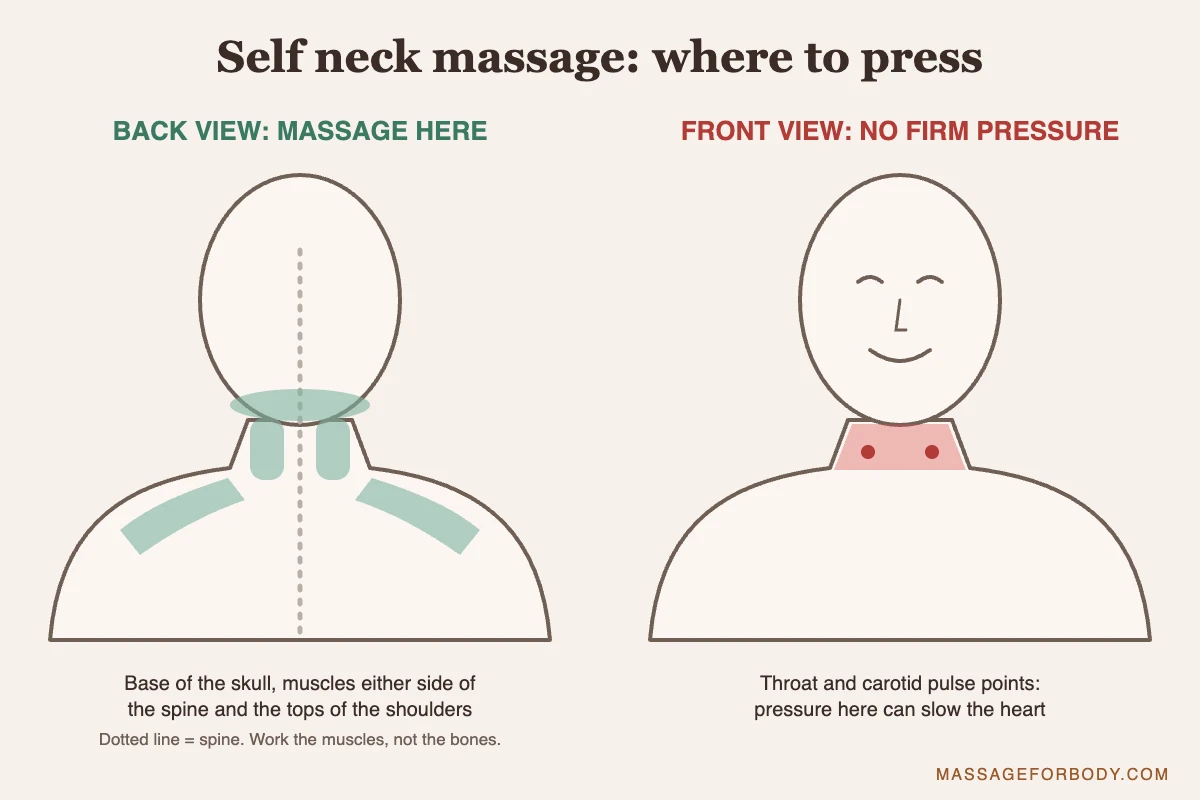
- The front of your throat, where your windpipe and voice box sit.
- The front sides of your neck, beside the windpipe, where you can feel your pulse. Pressing on the carotid artery here can slow the heart and lower blood pressure, which is why doctors only press this area as a monitored test.
- The bones of your spine. Work the muscles either side, not the bony bumps.
- Any lump, swelling or unexplained very tender spot. Leave it alone and get it checked.
If you feel dizzy, light-headed or faint, or notice tingling or numbness in your arms during a neck massage, stop straight away.
Neck and Shoulder Tension at Your Desk
Neck tension rarely stops at the neck. Pair your self neck massage with the posture changes Mayo Clinic recommends: keep your screen at eye level, support your back when you sit, and hold your phone or tablet up in front of you rather than bending your neck to look down. Short movement breaks through the day help too.

If the ache spreads into your shoulders, our shoulder pain massage guide has more techniques, and you’ll find more ideas for the whole body in how to massage yourself.
How Often Should You Massage Your Neck?
A self neck massage once or twice a day, for about five minutes, is plenty for everyday stiffness. There’s no need to dig harder or go longer; muscles that feel bruised the next day are a sign you overdid it.
Research on professional massage suggests frequency matters. In a 2014 trial in the Annals of Family Medicine, 228 adults with chronic neck pain did better with 60-minute massages two or three times a week than with shorter or less frequent sessions. Self-massage isn’t the same as professional treatment, but short, regular sessions are a sensible way to stop tension building up between appointments.
When Does Neck Pain Need a Doctor?
Most everyday neck stiffness eases within a few days. According to Mayo Clinic, call 911 or get emergency care for severe neck pain after an injury such as a car crash, diving accident or fall, or neck pain with weakness in an arm or leg, trouble walking or a high fever.
See a healthcare provider if your neck pain:
- gets worse despite self-care
- lasts several weeks despite self-care
- spreads down your arms or legs
- comes with a headache, numbness, weakness or tingling

If your neck feels worse after a professional massage, our article on neck pain after a massage explains the common causes.
Frequently Asked Questions
Can I use a massage gun on my neck?
You can use one on the back of your neck and the tops of your shoulders on a low setting with a soft attachment, but keep it brief and stay off the front and sides of your throat and the bones of your spine. Many people find their hands or a soft ball easier to control here. Our massage gun neck guide explains how.
Why does my neck crunch when I massage it?
Crunching or crackling sounds during a neck massage are common and usually harmless. They may come from gas bubbles in the joints or tissues sliding over each other. If the sounds come with pain, swelling, numbness or reduced movement, have it checked by a doctor or physical therapist. Our article on neck crunching during massage covers the possible causes.
Should I use heat or ice before a neck massage?
For everyday stiffness, warmth before massage helps muscles relax. After a fresh strain, Mayo Clinic suggests ice for up to 15 minutes several times a day for the first 48 hours, then switching to heat, such as a warm shower or a heating pad on low. Wrap ice packs in a towel and don’t leave heat on your skin for long periods.
Can a neck massage cause a headache?
Occasionally, especially if the pressure was too firm or you were already tense or dehydrated. A mild headache usually fades within a day with water and rest. Use lighter pressure next time and avoid long, deep work at the base of your skull. A sudden, severe headache, or one with fever or a stiff neck, needs urgent medical attention.
Is it safe to massage your own neck every day?
For most people, yes. A gentle five-minute self neck massage once or twice a day is safe. Keep the pressure comfortable, stay off the front of your neck and the spine, and skip areas with injuries, rashes or recent surgery. If you need it every day for weeks just to stay comfortable, ask a doctor or physical therapist to find the cause.
The Bottom Line
A self neck massage takes about five minutes and needs nothing but your hands: shoulder squeezes, circles under the skull, squeezes down the back of the neck, strokes down the sides and a few gentle turns. A tennis ball against the wall takes care of the spots between your shoulder blades.
Keep the pressure comfortable, stay off the front of your neck and the spine, and pair the routine with better screen and phone posture. If pain spreads, lingers for weeks or comes with numbness or weakness, see a doctor rather than pressing harder.
References
- Mayo Clinic. Neck pain: When to see a doctor.
- Sherman KJ, Cook AJ, Wellman RD, et al. Five-week outcomes from a dosing trial of therapeutic massage for chronic neck pain. Annals of Family Medicine. 2014;12(2):112–120.
- Huffman GB. Performing carotid sinus massage in elderly patients. American Family Physician. 2001;64(5):848–853.
Disclaimer:
This article is for general information only and is not a substitute for professional medical advice, diagnosis or treatment. See a doctor or physical therapist about neck pain that is severe, lasting or getting worse, and call 911 for emergency symptoms such as weakness, trouble walking or neck pain after an injury.