If you’ve come across the term lingam massage, you may have found a confusing mix of spiritual language, bold promises and very little practical or health information. This guide takes a calmer, more honest approach.
Below, we explain what lingam massage is, where the word comes from, how it differs from tantric and prostate massage, and why consent and communication sit at the heart of it. We also cover hygiene, sexual health and the signs that mean it’s time to see a doctor. This article is educational and written for adults.
Quick Answer: What Is Lingam Massage?
Lingam massage is an intimate, tantra-inspired massage of the penis and surrounding area, usually shared between consenting adult partners. It focuses on slow touch, breathing and relaxation rather than reaching orgasm. The word lingam comes from Sanskrit and refers to a sacred Hindu symbol of the god Shiva. It isn’t a service licensed massage therapists offer, and clear consent, good hygiene and sexual health care matter more than any technique.
Table of Contents
What Is Lingam Massage?
In Western wellness and tantra circles, “lingam massage” describes a slow, mindful massage of the penis, testicles and nearby areas such as the inner thighs and lower belly. It’s usually given by one partner to another, sometimes as part of a longer tantric massage.
What sets it apart from simply sexual touch is its intention. The giver focuses on unhurried, attentive touch, and the receiver focuses on breathing and noticing sensation. Orgasm isn’t the goal. Many people describe it as a way to slow down, build trust and communicate more openly about touch.
It’s worth being clear about what lingam massage isn’t. It isn’t a medical treatment, and there’s no research showing it treats sexual or other health conditions.

What Does “Lingam” Mean?
Lingam (also written linga, and sometimes misspelled “lingham”) is a Sanskrit word with deep religious significance. In Hinduism, the lingam is a sacred symbol of the god Shiva. It’s often shown together with the yoni, the symbol of the goddess Shakti, and together they represent the union of male and female principles and the ongoing cycle of creation, according to Encyclopaedia Britannica.
Tantra itself is a broad family of Hindu and Buddhist traditions, with texts more than a thousand years old covering philosophy, yoga, ritual and meditation. The modern Western “lingam massage” borrows the name and some ideas, such as breath and mindful attention, but it isn’t a traditional Hindu ritual. It’s more accurate to call it a modern, tantra-inspired practice, and to use the word with respect for its religious meaning.
Lingam Massage vs Tantric Massage vs Prostate Massage
These terms often get mixed up. Here’s how they differ:
- Tantric massage: a broader, slow, full-body massage built around breath, presence and connection. Lingam massage may be one part of it. See our guide to what tantric massage is.
- Lingam massage: focuses on the penis and surrounding area, approached in the same slow, mindful way.
- Yoni massage: the equivalent practice for the vulva. Learn more in our article on yoni massage.
- Prostate massage: involves stimulating the prostate, either externally through the perineum or internally. It’s a separate practice with its own safety considerations, covered in our guide to external prostate massage.
Is Lingam Massage Sexual?
Yes. It’s an intimate practice involving the genitals, even though its focus is relaxation and connection rather than orgasm. That has two practical implications.
First, it belongs in a relationship between consenting adults. Second, it isn’t part of professional massage therapy. In the US, licensed massage therapists follow codes of ethics that forbid sexual conduct with clients. The National Certification Board for Therapeutic Massage & Bodywork (NCBTMB), for example, requires practitioners to refrain from sexual conduct with clients under all circumstances, even if the client consents. A licensed therapist won’t offer lingam massage, and you shouldn’t ask one to.
Arousal can still happen during an ordinary, non-sexual massage, and that’s a normal body response. Our article on erections during a massage explains how to handle it calmly.
Consent and Communication Come First
Good lingam massage starts long before anyone touches anyone. Talk about it at a relaxed time, not in the heat of the moment.
Before
- Agree on what’s on and off the table, including which areas are OK to touch.
- Choose a simple stop word or signal, and agree that either person can use it at any time without explaining why.
- Talk about sexual health, including recent STI testing.
- Agree that there’s no expectation of anything more afterward.
During
- Check in often with simple questions such as “How’s this pressure?” or “Do you want me to keep going?”
- Watch body language as well as words. Tensing up, holding the breath or going quiet can mean someone wants to pause.
- Stop immediately if asked. Consent can change at any point.
After
- Spend a few minutes resting together.
- Share what felt good and anything you’d change next time, kindly and without pressure.

How Couples Approach a Lingam Massage
There’s no single “correct” method, and this isn’t a step-by-step technique guide. Most approaches share a similar calm structure:
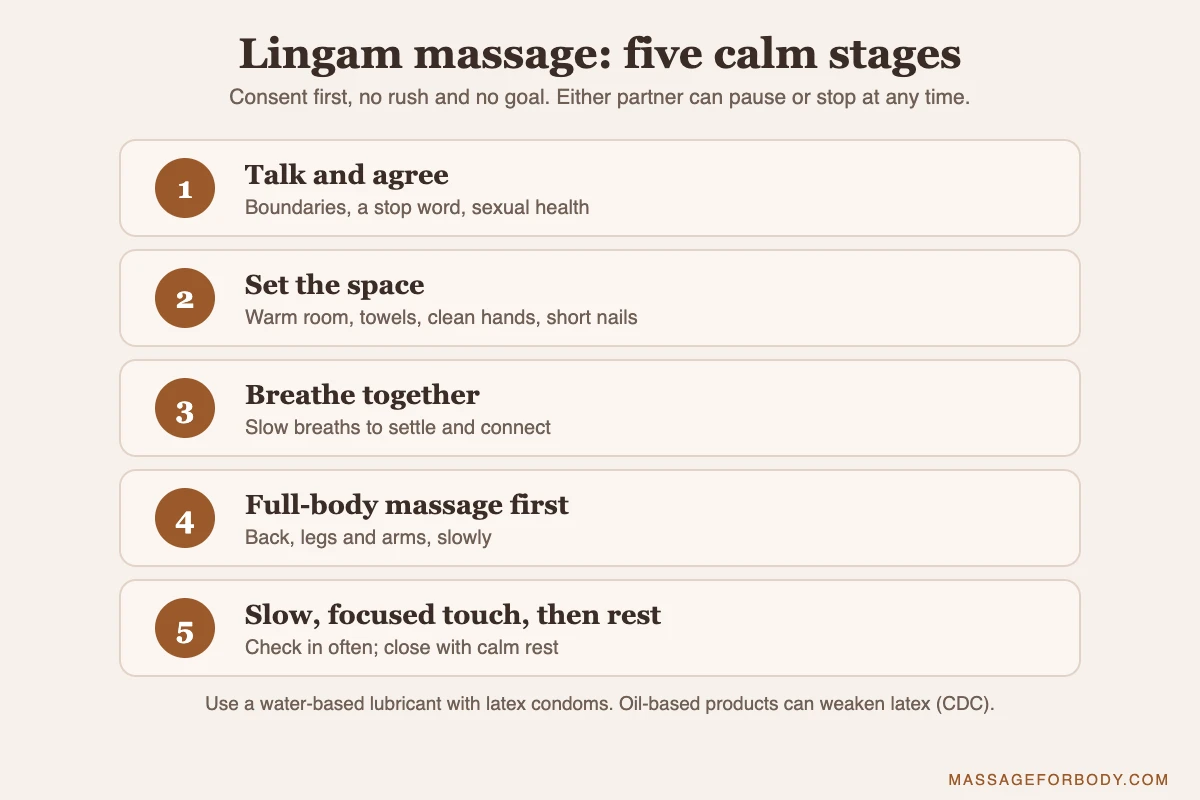
- Talk and agree. Revisit your boundaries and your stop word.
- Set the space. Choose a warm, private room with soft lighting and towels. Wash your hands and keep nails short and smooth.
- Breathe together. A few minutes of slow breathing helps you both settle.
- Full-body massage first. Start with the back, legs and arms so the receiver can relax before any intimate touch.
- Slow, focused touch, then rest. Keep touch gentle, unhurried and responsive to feedback, then finish with quiet rest rather than rushing off.
The person receiving can stay focused on their breath, and the person giving should focus on listening rather than performing. For ideas for the full-body part, see our guide on how to give a tantric massage.
Hygiene, Lubricants and Sexual Health
- Wash first. Both partners should wash their hands, and nails should be short and smooth to avoid scratches.
- Choose lubricant carefully. If you use latex condoms, use a water-based lubricant. The CDC warns that oil-based products such as petroleum jelly and body lotions can weaken latex and cause condoms to break.
- Keep fragranced oils away from genitals. Scented massage oils and essential oils can irritate sensitive skin. Test any new product on a small patch of skin first.
- Know how STIs spread. According to the CDC, sexually transmitted infections can spread through genital skin-to-skin contact, not just intercourse. Regular testing and open conversations with partners help lower the risk.
- Skip it if anyone has symptoms. Sores, unusual discharge, a rash or pain are reasons to pause and see a healthcare provider.

Possible Benefits, Honestly
There’s no published research on lingam massage itself, so be wary of websites that promise it will cure erectile dysfunction, premature ejaculation or other conditions.
What people commonly report is more modest: feeling more relaxed, more connected with a partner, more comfortable talking about touch and boundaries, and more aware of their own body. Those can be worthwhile in themselves. If you’re dealing with a sexual health concern such as ongoing erectile difficulties, talk to a doctor, since these can sometimes be linked to other health conditions.

When to Skip It or See a Doctor
Skip lingam massage and talk to a healthcare provider if:
- you have pain, swelling or an injury in the genital area
- you or your partner have symptoms of an STI, such as sores, unusual discharge or burning
- you notice a new bend, a hard lump or band, or pain with erections; Mayo Clinic notes these can be signs of Peyronie’s disease, and early treatment gives the best chance of improvement
- you’ve recently had surgery in the area
Get urgent medical care for sudden, severe pain or swelling in the penis or testicles.
Frequently Asked Questions
Is lingam massage the same as tantric massage?
Not quite. Tantric massage is a broader, slow, full-body massage built around breath and connection, while lingam massage focuses on the penis and surrounding area. A lingam massage is sometimes included as one part of a longer tantric massage. Both are modern, tantra-inspired practices rather than traditional Hindu rituals, and both depend on clear consent between adult partners.
Can you get a lingam massage from a massage therapist?
No. Licensed massage therapists in the US follow codes of ethics that prohibit sexual conduct with clients, even if the client consents. A professional massage will never include genital contact, and you shouldn’t ask for it. Lingam massage is something consenting adult partners choose to share privately, ideally after talking openly about boundaries and sexual health.
What does lingam mean?
Lingam is a Sanskrit word. In Hinduism, the lingam is a sacred symbol of the god Shiva, often shown with the yoni, the symbol of the goddess Shakti. Together they represent the union of male and female principles and the cycle of creation. Because the word has religious meaning, it’s worth using it respectfully and understanding that lingam massage is a modern adaptation.
Does lingam massage help with erectile dysfunction?
There’s no research showing that lingam massage treats erectile dysfunction or any other sexual health condition. Some people find that slow, pressure-free touch helps them relax and feel less anxious, but that isn’t a medical treatment. Ongoing erectile difficulties can sometimes be linked to other health conditions, so it’s worth talking to a doctor about them.
What oil is best for lingam massage?
If you’re using latex condoms, choose a water-based lubricant, because the CDC warns that oil-based products can weaken latex. Without condoms, a plain, unscented product may feel smoother, but keep fragranced oils and essential oils off genital skin, as they can irritate it. Test anything new on a small patch of skin first, and stop if you notice burning, redness or itching.
How long does a lingam massage last?
There’s no set length. Many couples spend 30 to 60 minutes in total, including time to talk, breathe and give a full-body massage before any intimate touch. The pace matters more than the clock. Take as long as feels comfortable for both of you, check in often and leave time to rest together afterward.
The Bottom Line
Lingam massage is a modern, tantra-inspired practice that some couples use to slow down, relax and connect. It’s intimate, it isn’t offered by licensed massage therapists, and it works best when consent, communication and sexual health come first.
Approach the word itself with respect for its religious meaning, keep your expectations realistic, and see a doctor about any pain, changes or symptoms rather than expecting massage to fix them. For more on this topic, explore our intimate wellness guides.
References
- Encyclopaedia Britannica. Yoni.
- Encyclopaedia Britannica. Hinduism: Tantrism.
- National Certification Board for Therapeutic Massage & Bodywork. Code of Ethics.
- Centers for Disease Control and Prevention. How to Prevent STIs.
- Centers for Disease Control and Prevention. Condom Use: An Overview.
- Mayo Clinic. Peyronie’s disease: Symptoms and causes.
Disclaimer:
This article is for general educational purposes for adults and is not a substitute for professional medical advice, diagnosis or treatment. See a doctor or sexual health clinic about genital pain, changes or symptoms of an STI, and seek urgent care for sudden, severe pain or swelling.