Whether it comes from hunching over a laptop, sleeping awkwardly or a tough workout, shoulder pain has a way of creeping into everything you do. Massage for shoulder pain is one of the simplest ways to ease tight, aching muscles, and you can do much of it yourself.
This guide covers what massage can realistically do, a 5-minute self-massage routine, how to give someone else a shoulder massage and the gentle exercises that help the relief last. You’ll also find the warning signs that mean shoulder pain needs a doctor rather than a massage.
Quick Answer: How to Massage Shoulder Pain
Warm the area first, then knead the top of the shoulder between your fingers and palm, work between the shoulder blades with a tennis ball against a wall, and make slow circles over the back of the shoulder. Use firm but comfortable pressure for about five minutes, then follow with gentle exercises such as pendulum swings. Skip massage if the shoulder is swollen, recently injured or you can’t lift your arm.
Table of Contents
Can Massage Help Shoulder Pain?
For everyday muscle tension, massage for shoulder pain can help. In a small trial of 29 people with shoulder pain, six sessions of soft tissue massage around the shoulder improved pain, range of motion and day-to-day function compared with people who had no treatment while they waited.
Massage works best as a partner to movement, though, not a replacement for it. In a larger 2015 trial of 80 adults, adding massage to a four-week shoulder exercise program didn’t improve pain, function or movement any more than the exercises alone. In other words, massage can take the edge off while exercise does the long-term work.
That’s why the routines below finish with three gentle moves from the American Academy of Orthopaedic Surgeons’ shoulder conditioning program.

What’s Causing Your Shoulder Pain?
Massage for shoulder pain is best suited to aches that come from tight or overworked muscles, such as:
- long hours at a desk or looking down at a phone
- sleeping in an awkward position
- carrying a heavy bag on one shoulder
- a hard workout or a new activity
- stress, since many people hold tension in the tops of their shoulders
Pain from inside the joint is different. Rotator cuff tears, tendinitis, frozen shoulder, arthritis and dislocations need a proper diagnosis, and firm massage over an injured tendon can make things worse. If your pain started with an injury, keeps getting worse or makes it hard to lift your arm, see a doctor or physical therapist before trying massage.
If the ache sits between your shoulder blades, our guide to massaging the shoulder blade goes into more detail, and if it creeps up into your neck, try our 5-minute self neck massage.

How to Massage Your Own Shoulder: A 5-Minute Routine
This self-massage for shoulder pain takes about five minutes. Sit upright or stand, and if you can, take a warm shower or use a heating pad on low for a few minutes first. Use firm but comfortable pressure: you should feel a “good hurt” in tight spots, never sharp pain.
Step 1: Upper Shoulder Squeeze (1 Minute)
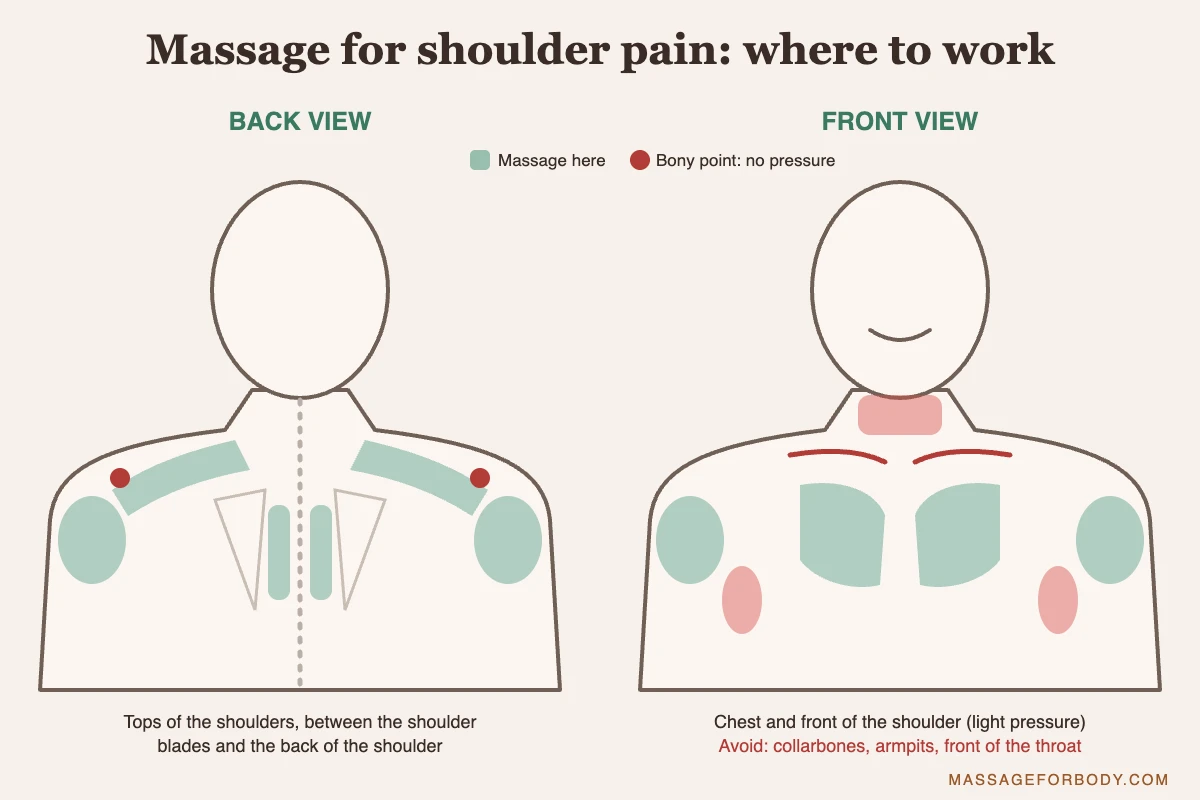
Reach your right hand across to your left shoulder and grip the thick muscle between your neck and the tip of your shoulder. Squeeze for 3 seconds, release and move a little along the muscle. Work for 30 seconds, then switch sides.
Step 2: Back of the Shoulder (1 Minute)
Cup your hand over the back of the opposite shoulder, just below the bony tip, and make slow, firm circles with your fingertips for 30 seconds per side. Stay on the muscle and off the bone.
Step 3: Between the Shoulder Blades With a Tennis Ball (2 Minutes)
Stand with your back to a wall and place a tennis ball between the wall and the muscle beside one shoulder blade. Lean in and bend your knees slightly to roll the ball up and down a few inches, pausing on tender spots for 20 to 30 seconds. Keep the ball off your spine, then switch sides.
Step 4: Chest and Front of the Shoulder (1 Minute)
Tight chest muscles pull the shoulders forward. With the opposite hand, make gentle circles on the fleshy area below your collarbone and toward the front of your shoulder for 30 seconds per side. Keep this pressure light and avoid pressing into the armpit.
If you use a massage gun, read our guide to using a massage gun on the rotator cuff before you start, as the shoulder needs a lighter setting than larger muscles.
How to Give Someone a Shoulder Massage
Massaging a partner’s shoulders is easier than doing your own because you can use both hands and some body weight. Have them sit on a chair facing backward, or lie face down, and use a little massage oil on bare skin.
- Warm up with long, gentle strokes from the base of the neck out across the shoulders for about a minute.
- Knead the tops of the shoulders with both hands, lifting and squeezing the muscle like dough.
- Use your thumbs to make small circles along the inner edge of each shoulder blade, staying off the spine.
- Glide the heels of your hands outward across the shoulder blades.
- Finish with a few light, sweeping strokes.
Check in about pressure every minute or so, and stop straight away if anything feels sharp. Our guide to giving a good back and neck massage has more partner techniques.

Three Gentle Moves to Pair With Massage
These exercises are part of the AAOS Rotator Cuff and Shoulder Conditioning Program. They should never hurt, so stop if they do, and ask your doctor or physical therapist which exercises suit you.
- Pendulum: lean forward with one hand on a table and let the other arm hang loose. Gently swing it forward and back, side to side, then in small circles. Do 2 sets of 10 each way.
- Crossover arm stretch: gently pull one arm across your chest, holding the upper arm rather than the elbow, until you feel a stretch at the back of the shoulder. Hold for 30 seconds, rest and repeat four times on each side.
- Shoulder blade setting: sit or stand tall and gently draw your shoulder blades back and down. Hold for a few seconds, release and repeat 10 times.
When Can Massage Make Shoulder Pain Worse?
Skip massage on the painful shoulder, or get it checked first, if you have:
- a recent fall, injury or dislocation
- swelling, redness or warmth around the joint
- sudden severe pain, or you can’t lift your arm away from your body
- numbness, tingling or weakness running down the arm
- recent shoulder surgery (follow your surgeon’s instructions)
- a known rotator cuff tear or fracture
Even when massage is fine, keep pressure off the collarbone and the bony tip of the shoulder, and treat the front of the shoulder gently.
When Should You See a Doctor About Shoulder Pain?
According to Mayo Clinic:
- Call 911 if shoulder pain comes with signs of a heart attack, such as trouble breathing, chest tightness or sweating.
- Go to urgent care or the emergency room after a fall or accident if your shoulder looks deformed, you can’t use it or lift your arm, or you have severe pain or sudden swelling.
- Make an appointment if your shoulder is swollen, red, warm or tender, the pain keeps getting worse, or it’s getting harder to move.
For minor shoulder pain, Mayo Clinic suggests resting from movements that hurt, ice for 15 to 20 minutes a few times a day, and over-the-counter pain relief used as directed. A physical therapist can build you a tailored exercise plan if the pain keeps coming back.

Frequently Asked Questions
How often should I massage my shoulder?
A few minutes of self-massage for shoulder pain once or twice a day is plenty for everyday tension. Keep the pressure comfortable and ease off if the area feels bruised or more painful the next day. Pair massage with gentle shoulder exercises, since research suggests movement does more for lasting relief than massage on its own.
Is deep tissue massage good for shoulder pain?
It can help stubborn muscle tension, but deeper isn’t always better. Firm pressure over an injured tendon, a recent strain or an inflamed joint can make pain worse. Ask your therapist to start at moderate pressure and check in often. If you have a diagnosed rotator cuff problem or frozen shoulder, ask your doctor or physical therapist first.
Should I use heat or ice for shoulder pain?
For a fresh strain or sudden flare-up, Mayo Clinic suggests ice for 15 to 20 minutes a few times a day. For everyday stiffness and tight muscles, many people find a warm shower or heating pad before massage helps the muscles relax. Wrap ice or heat in a towel and never fall asleep on a heating pad.
Can a massage gun help shoulder pain?
Used on a low setting over muscle, a massage gun can ease tightness in the upper back and the back of the shoulder. Keep it off the bony tip of the shoulder, the collarbone, the armpit and the neck, and don’t use it on a fresh injury. A minute or two per area is enough.
Why does my shoulder hurt more after a massage?
Mild soreness for a day or two after a firm massage is common, especially if the muscles were very tight. Water, gentle movement and warmth usually help it settle. Pain that is sharp, keeps getting worse or comes with swelling, numbness or weakness isn’t normal soreness and should be checked by a doctor.
The Bottom Line
Massage for shoulder pain works best for everyday muscle tension: a few minutes of kneading, circles and tennis ball work can ease stiffness and help you feel looser. Research suggests the lasting gains come from movement, so pair massage with gentle exercises such as pendulum swings and the crossover arm stretch.
Keep the pressure comfortable, stay off bony spots, and don’t massage a shoulder that is swollen, injured or hard to lift. If pain comes with chest tightness or breathlessness, call 911. For more ideas, browse our upper body massage guides.
References
- Mayo Clinic. Shoulder pain: When to see a doctor.
- van den Dolder PA, Roberts DL. A trial into the effectiveness of soft tissue massage in the treatment of shoulder pain. Australian Journal of Physiotherapy. 2003;49(3):183–188.
- van den Dolder PA, Ferreira PH, Refshauge KM. Effectiveness of soft tissue massage for nonspecific shoulder pain: randomized controlled trial. Physical Therapy. 2015;95(11):1467–1477.
- American Academy of Orthopaedic Surgeons (OrthoInfo). Rotator Cuff and Shoulder Conditioning Program.
Disclaimer:
This article is for general information only and is not a substitute for professional medical advice, diagnosis or treatment. See a doctor or physical therapist about shoulder pain that is severe, lasting or getting worse, and call 911 if shoulder pain comes with chest tightness, trouble breathing or sweating.