Some people book a massage once a year as a treat. Others swear by a weekly session. If you’re trying to work out what’s right for you, the honest answer is that there’s no single magic number.
How often you should get a massage depends mostly on why you’re getting one, how your body responds and what fits your budget. This guide breaks it down by goal, shares the schedules researchers actually used in studies of massage for neck and back pain, and explains when to space sessions out.
Quick Answer: How Often Should You Get a Massage?
For relaxation and general well-being, every two to four weeks suits many people, but there’s no evidence-based ideal. For chronic pain, research has used more frequent sessions at first, such as weekly one-hour massages for 10 weeks for low back pain, or 60-minute sessions two to three times a week for neck pain, before tapering. Space deep tissue sessions until soreness has settled, and check with your provider first if you’re pregnant or have a health condition.
Table of Contents
How Often Should You Get a Massage? It Depends on Your Goal
Use this as a starting point, then adjust based on how you feel after each session.
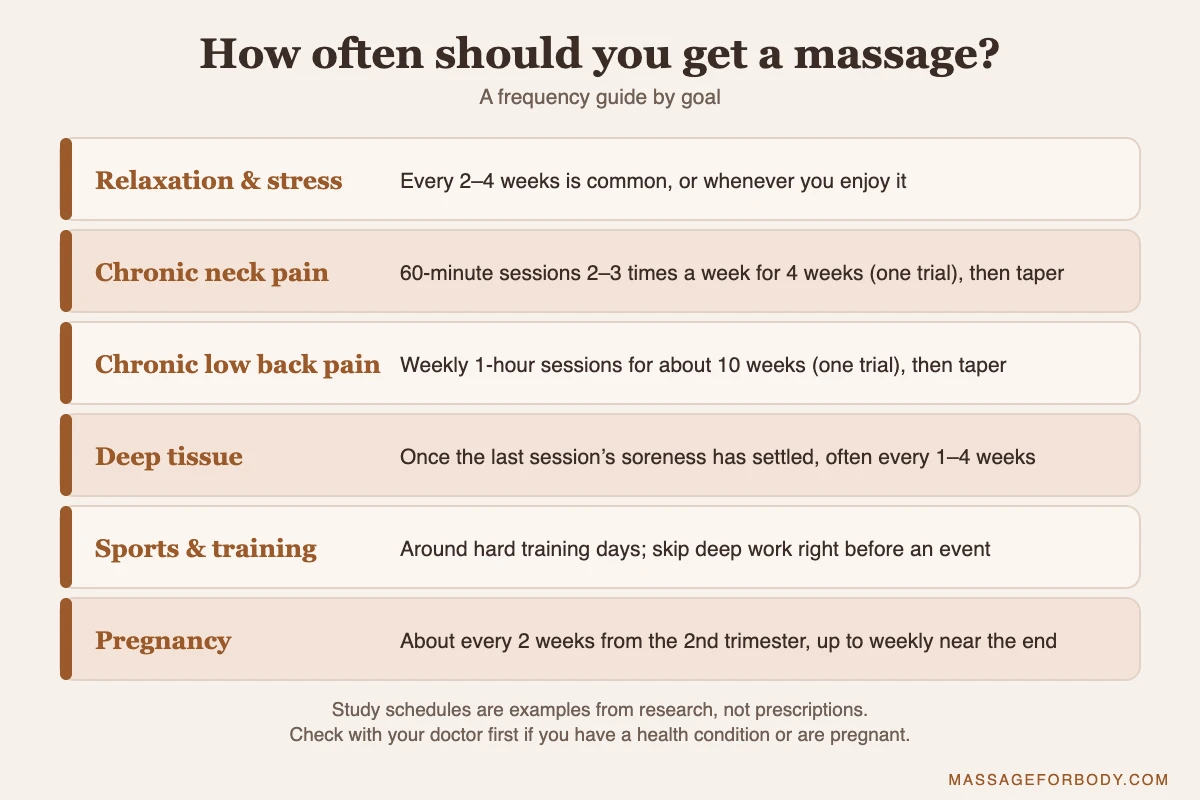
- Relaxation and stress relief: every two to four weeks is a common rhythm, but this comes down to preference and budget rather than a medical rule. Monthly is plenty for many people.
- Chronic neck pain: in one trial, 60-minute sessions two or three times a week for four weeks worked better than shorter or less frequent sessions.
- Chronic low back pain: a large trial used one-hour massages once a week for 10 weeks.
- Deep tissue massage: wait until the soreness from your last session has settled. Many people book every one to four weeks.
- Sports and training: schedule sessions around your hardest training days and avoid deep work right before an event.
- Pregnancy: Cleveland Clinic suggests about every two weeks from the second trimester, and up to weekly near the end of the third, with your provider’s OK.
What the Research Says About Massage Frequency
Few studies have tested massage “doses” directly, but two well-known US trials give useful clues.
Neck pain: longer, more frequent sessions worked best
In a 2014 trial published in the Annals of Family Medicine, 228 adults with chronic neck pain were randomly assigned to one of five massage schedules for four weeks or to a wait list. Sixty-minute massages two or three times a week led to meaningful improvements in pain and neck function, while 30-minute sessions didn’t clearly beat no massage. The researchers concluded that several 60-minute massages a week were more effective than fewer or shorter sessions.
Low back pain: weekly sessions for 10 weeks
In a 2011 trial in the Annals of Internal Medicine, 401 adults with chronic low back pain received either 10 weekly one-hour massages (relaxation or structural massage) or their usual care. At 10 weeks, both types of massage improved function and pain more than usual care. The benefit shrank over the following months, although some improvement in function was still present at one year.
The National Center for Complementary and Integrative Health (NCCIH) notes that massage benefits are often short-term, and that for neck pain, sessions need to be long and frequent enough to help. That’s the main reason people with ongoing pain choose a regular schedule rather than a one-off visit.

How Often to Get a Massage for Pain: Start More Often, Then Taper
If you’re using massage alongside other care for an ongoing ache, a front-loaded plan often makes sense:
- Start more often. Book one or two sessions a week for the first few weeks, similar to the schedules used in research.
- Check your progress. After four to six weeks, look at whether your pain, sleep or daily activities have improved.
- Taper. If you’re better, stretch the gap to every two weeks, then monthly, and see whether the improvement holds.
- Reassess. If nothing has changed after several sessions, talk to your doctor or physical therapist about other options.
Massage isn’t a substitute for medical care. NCCIH advises against using massage to delay seeing a provider about a medical problem, so get new, severe or worsening pain checked first.
How Often Should You Get a Deep Tissue Massage?
Deep tissue massage uses slow, firm pressure, so your body needs a little more time between sessions. Mild soreness after a massage is common for a day or so. A good rule is to book your next session only once that soreness has fully settled, which usually takes at least a few days.
For ongoing tension or a specific problem, weekly deep tissue sessions can work for some people. For maintenance, every two to four weeks is more typical. If you’re still sore when your next appointment comes around, space them further apart or ask for lighter pressure. Our guides to what to expect from a deep tissue massage and what to do after a deep tissue massage can help you get the most from each session.

How Often Should Athletes Get a Massage?
Active people often plan massage around their training rather than the calendar. A lighter session after a hard block of training can feel good, and many athletes book a regular massage every week or two when their training load is high.
Timing matters as much as frequency. Avoid a new or very deep massage in the day or two before a race or competition, when unexpected soreness is the last thing you need. A light, familiar session is a safer choice close to an event. See our guides to massage after a workout and sports massage for more.

How Often Can You Get a Massage During Pregnancy?
Prenatal massage can ease the aches of pregnancy, but timing and approval matter. Cleveland Clinic notes that most providers recommend waiting until the second trimester, then suggests about one massage every two weeks, increasing to up to once a week near the end of the third trimester.
Always check with your OB-GYN or midwife first, especially if you have high blood pressure, gestational diabetes, a history of blood clots or another complication. Choose a therapist trained in prenatal massage who uses side-lying positions. Our guide to massage during pregnancy covers what to expect.

Can You Get a Massage Every Day?
Daily professional massage isn’t necessary for most people, and it gets expensive. Gentle self-massage or a light session most days is unlikely to cause problems for healthy adults, but deep or intense work every day doesn’t give your tissues time to recover.
Signs you may be booking too often or going too deep:
- soreness that hasn’t settled before your next session
- new bruising or lingering tenderness
- feeling more tired or achy afterward instead of better
- dreading sessions because they hurt
Mayo Clinic says you shouldn’t feel severe pain during a massage, so ask for lighter pressure if it hurts. Read more in our article on whether too much massage can be harmful.
Who Should Check With a Doctor First?
Massage is generally safe when a trained professional does it, but Mayo Clinic recommends talking with your healthcare team and therapist first if you:
- have had a recent heart attack or a recent blood clot in a leg
- have a bleeding disorder or take blood thinners
- have burns, healing wounds or broken bones
- have severe osteoporosis
- are pregnant or being treated for cancer
How to Make Regular Massage More Affordable
- Check your insurance. Some plans cover massage therapy when a doctor prescribes it for a medical reason. Our guide on getting insurance to pay for massage therapy explains how.
- Use pre-tax accounts. FSA and HSA funds can sometimes be used for massage therapy with a letter of medical necessity. Some massage devices may qualify too; see are massage guns FSA eligible.
- Ask about packages or memberships. Many clinics and spas discount a series of sessions booked together.
- Mix session lengths for maintenance. Once you’re feeling good, alternating full sessions with shorter ones focused on your problem area can keep costs down.
- Learn self-massage. A few minutes a day between appointments can help you stay loose. Start with our guide to giving yourself a massage.
Frequently Asked Questions
How often should you get a massage for stress?
There’s no research-based ideal, so let your budget and how you feel guide you. Many people find a massage every two to four weeks keeps stress in check, while others prefer monthly. If you notice tension creeping back sooner, try booking a little more often for a while. Simple habits at home, such as self-massage, stretching and regular movement, can help in between sessions.
Is it OK to get a massage every week?
Yes, for most healthy adults a weekly massage is fine, especially at a comfortable pressure. Research trials for chronic back and neck pain used weekly or even more frequent sessions. If you’re getting deep tissue work weekly, make sure the soreness has settled between sessions. Check with your doctor first if you have a health condition, take blood thinners or are pregnant.
How often should you get a deep tissue massage?
Book your next deep tissue massage once the soreness from the last one has fully settled, which usually takes at least a few days. For a specific problem, some people go weekly for a short period. For ongoing maintenance, every two to four weeks is more typical. If you’re still sore by your next appointment, space sessions further apart or ask for lighter pressure.
How often should you get a massage for back pain?
In a large US trial, adults with chronic low back pain had one-hour massages once a week for 10 weeks, and both relaxation and structural massage improved function more than usual care. Many people start with weekly sessions, then taper to every two weeks or monthly as they improve. See a doctor for back pain that is severe, new, or comes with numbness or weakness.
Can you get two massages in one week?
Yes, in many cases. In a neck pain trial, 60-minute massages two or three times a week worked better than less frequent or shorter sessions. If you book twice in one week, keep the pressure comfortable, leave at least a day between sessions and notice how your body responds. Space them out if you feel sore, bruised or more tired afterward.
How long do the benefits of a massage last?
It varies from person to person. Many people feel looser and more relaxed for a day or two after a session. For pain, NCCIH notes that benefits are often short-term, and in a large low back pain trial, improvements were strongest at 10 weeks and shrank over the following year. That’s why people with ongoing pain often choose regular sessions rather than a single visit.
The Bottom Line
So, how often should you get a massage? For relaxation, as often as you enjoy and can afford, with every two to four weeks a popular rhythm. For ongoing pain, research suggests more frequent sessions at first, then tapering as you improve. Give deep tissue work time to settle, plan around big training days, and get your provider’s OK during pregnancy.
Most of all, listen to your body. If you feel better between sessions, your schedule is working. If you’re always sore or not improving, change the plan or talk to a professional. Explore more in our massage benefits guides.
References
- Sherman KJ, Cook AJ, Wellman RD, et al. Five-Week Outcomes From a Dosing Trial of Therapeutic Massage for Chronic Neck Pain. Annals of Family Medicine. 2014;12(2):112–120.
- Cherkin DC, Sherman KJ, Kahn J, et al. A comparison of the effects of 2 types of massage and usual care on chronic low back pain: a randomized, controlled trial. Annals of Internal Medicine. 2011;155(1):1–9.
- National Center for Complementary and Integrative Health. Massage Therapy: What You Need To Know.
- Mayo Clinic. Massage therapy.
- Cleveland Clinic. Prenatal Massage: Is It Safe?
Disclaimer:
This article is for general information only and is not a substitute for professional medical advice, diagnosis or treatment. Talk with your doctor before starting regular massage if you are pregnant, have a health condition or take blood thinners, and don’t use massage to delay care for new, severe or worsening pain.